
Long Island, New York
Bat Removal in Nassau County.
There is one way to do this right, and it is not a same day patch. Bats are never killed or trapped. We let the colony out with one-way devices, clean the droppings safely, re-insulate, and seal every tiny gap so they cannot come back.
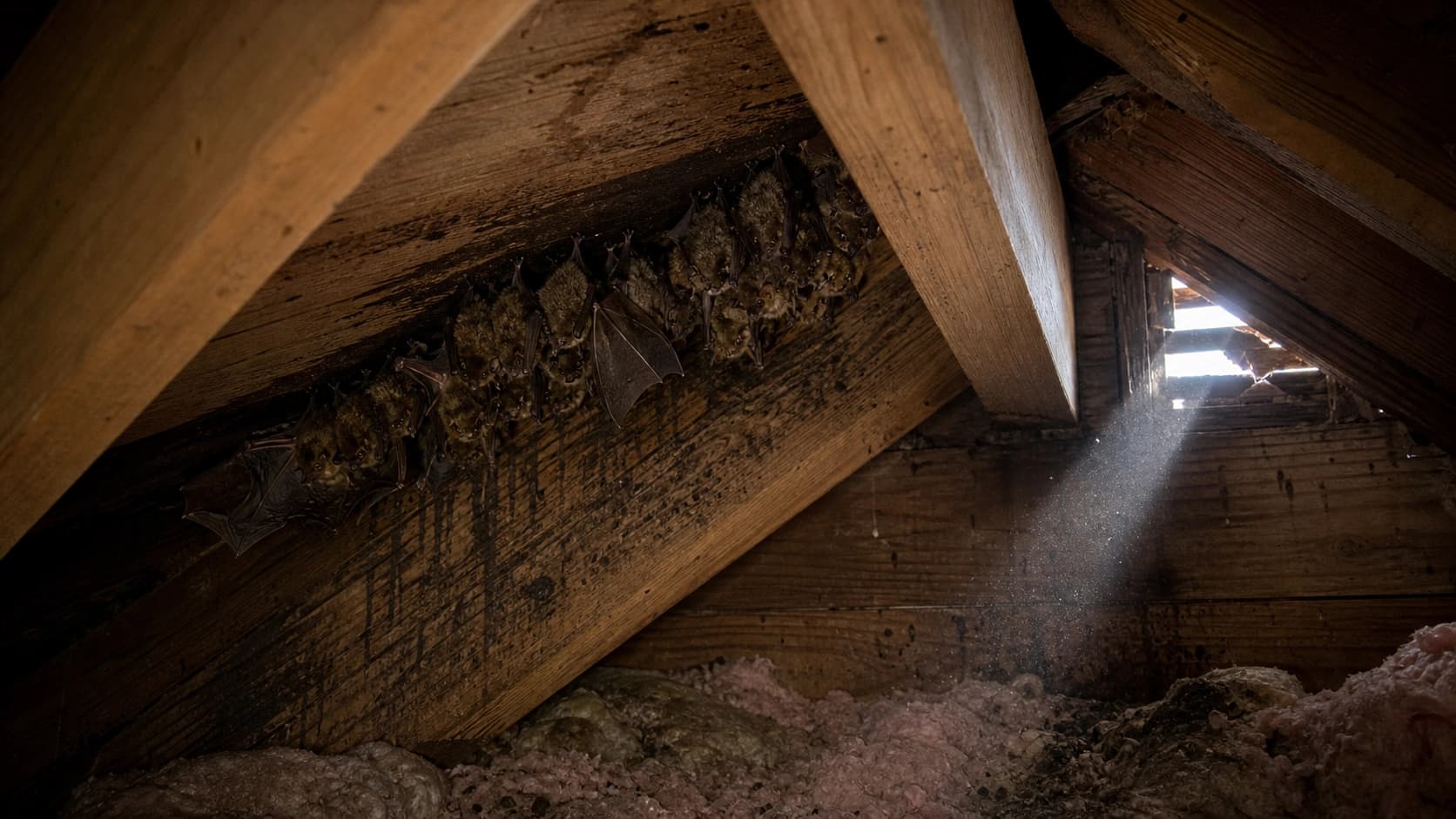
One bat is a sign. A colony is the problem.
Most homeowners see one bat and think it wandered in. By the time you spot it, a colony has often been roosting in your attic for weeks, slipping in through a gap as small as three eighths of an inch, about the width of a pencil. They tuck into the eaves (the underside of the roof where it overhangs the wall) and the peak, and the droppings pile up out of sight. On the older Capes through Levittown and Hempstead, the walk-up attic over the stairs is exactly the warm, dark, undisturbed space a colony wants.
This is not a job you rush or fake. The droppings, called guano, carry a real health risk, and the salt air off the water grows mold in fouled insulation faster than inland. We do the whole job the right way: let the colony out with one-way devices, clean what they left, put the attic back together, and seal every gap so the next colony has nowhere to get in.
One crew, start to finish
What a real bat job looks like
Find every gap, down to 3/8 of an inch
A bat slips through an opening as small as three eighths of an inch, about the width of a pencil. We walk the roofline and the attic and photograph every one of them: the lifted ridge cap (the capping that runs along the very peak of the roof), the gap behind the fascia (the flat board the gutter hangs on), the worn flashing (the metal seal where the roof meets a wall or chimney). Miss one gap and the colony keeps coming back, so finding all of them is the whole game.
Get them out the right way
Bats are never killed, trapped, or poisoned. The method that actually works is a one-way exclusion device: it lets every bat fly out to feed at dusk and blocks the way back in. We time this around baby season, roughly June through July, when flightless pups are in the roost. We do not seal anything shut until the whole colony, pups included, can fly out, so nothing gets stranded inside your attic.
Clean the droppings safely
Bat droppings, called guano, pile up in the insulation and carry a real health risk: dried guano can release fungal spores that cause histoplasmosis, a lung infection. This is not a job for a shop vac and a dust mask. We remove the fouled insulation under the right protection, decontaminate the deck (the wood surface under the roof), and document every inch with photos.
Re-insulate and seal every gap
Fresh insulation goes back, and every opening, every one of those three-eighth-inch gaps, is sealed for good. With PSEG Long Island electric among the highest rates in the country, that new insulation starts paying you back on the bill the first month. A sealed attic is a quiet attic, and the colony has nowhere left to land.
Why one crew beats an exclusion plus three other contractors
Plenty of Long Island companies will hang a one-way device and call the bats handled. Then you are left with the guano in your insulation and a roofline full of gaps. Call an insulation company for the fouled insulation, a cleaning company for the droppings, a handyman for the openings. Three trucks, three invoices, three people each pointing at the last. We send one crew that does the exclusion, the safe cleanup, the re-insulation, and the sealing in one job, and photographs every step, so nothing falls through the gap between trades, and there is no gap left for the next colony to use either.
See exactly how it's done.
The Attic Fanatics videos have pulled tens of millions of views by showing the real work: real attics, real colonies, and the before-and-after most contractors will never put on camera. Watch what we actually do before you let anyone into your home.
Watch on InstagramBat questions, answered
Will the bats come back after the exclusion?
Not through the openings we seal. The one-way devices let the colony leave for good, and then we close every gap we found, down to three eighths of an inch, with materials that hold. If you ever hear scratching or squeaking again, call the office and Attic Fanatics handles it directly with you. We sort out every situation one on one with the homeowner rather than printing a promise on a web page.
Can you just kill the bats or get rid of them today?
Bats are not killed, trapped, or poisoned, and any company that promises a same day fix is selling you a patch job. The way this actually gets solved is one-way exclusion: devices that let the colony fly out to feed and keep them from getting back in. It is slower by design, because we time it so the pups are never sealed in, but it is the method that actually clears the colony for good.
Why does the timing matter so much?
Because of baby season. From roughly June through July, the colony has flightless pups in the roost. If you seal the attic then, the pups are trapped inside and you are left with dead animals rotting in your insulation. We schedule the exclusion around that window so the whole colony, pups included, can fly out before anything is sealed.
Do I need new insulation after bats?
Usually yes. Bat guano builds up in the insulation and carries a health risk, histoplasmosis, from fungal spores in the dried droppings. On Long Island the coastal salt air and humidity grow mold in soaked insulation faster than inland, so the fouled material has to come out. We remove it, decontaminate the area, and replace it with fresh insulation, matched to your attic.
What does bat removal cost in Nassau County?
It depends on what the colony got into. A straightforward exclusion and sealing on a clean attic is one thing. A full job where guano-fouled insulation has to be removed, the attic decontaminated, and fresh insulation put back is a bigger one, because the contaminated insulation is the largest part of the work. We price it after we see the attic, never over the phone. Our costs page walks through the honest factors that move the number up or down.
Reserve an inspection
Tell us what you're seeing or hearing. We schedule a visit, walk the attic, photograph every gap, and write the plan around baby season timing. No phone guesses, and we will tell you straight what the attic actually needs.