On this page
On this page
- What makes insulation "contaminated"?
- What health risks come from raccoon-contaminated insulation?
- What health risks come from mouse or rat-contaminated insulation?
- What about bat-related contamination?
- Can contaminated insulation affect indoor air quality?
- When should contaminated insulation be removed?
- What does professional insulation removal and replacement involve?
- Step 1: Containment and protection of living space
- Step 2: Industrial HEPA vacuum removal of all contaminated material
- Step 3: Antimicrobial decontamination of exposed surfaces
- Step 4: Air sealing of all penetrations
- Step 5: Installation of fresh insulation
- Frequently Asked Questions
- Protect Your Family and Your Home
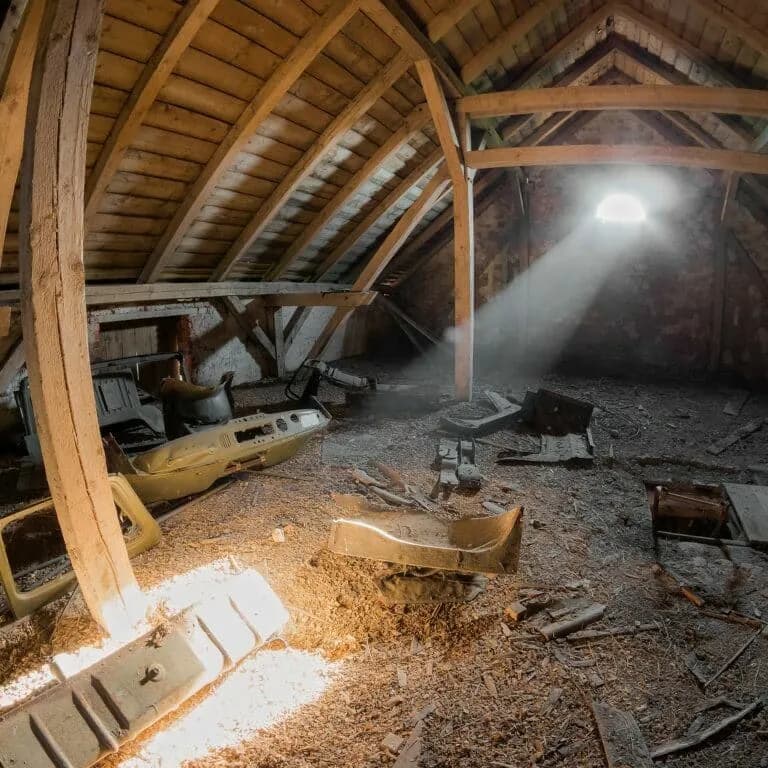
Yes, contaminated attic insulation can become a serious air quality and cleanup concern. Rodent and raccoon activity can leave urine, droppings, nesting debris, odor, and residue embedded in porous insulation. Bat activity can also leave affected attic material that needs to be inspected before cleanup is quoted.
The question is not whether every attic needs the same response. The question is what kind of contamination you are dealing with, where it is located, how much insulation is affected, and what work actually makes sense.
What makes insulation "contaminated"?
Attic insulation becomes contaminated when wildlife takes up residence in the attic. The contamination takes several forms:
- Urine saturation. Mice, rats, and raccoons urinate as they travel. Over weeks or months, urine soaks into the insulation and spreads well beyond the visible damage.
- Fecal matter. Droppings from wildlife accumulate in the insulation. Raccoons tend to create concentrated latrine sites, while mice and rats scatter droppings throughout their travel paths.
- Nesting debris. Squirrels, mice, and raccoons pull insulation apart to build nests. They drag in outside material, leaves, paper, food scraps, and other organic matter that breaks down over time.
- Decomposition. Animals die in attics. A single decomposing carcass contaminates the surrounding insulation with bacteria and attracts secondary pests.
Here is the critical detail that most homeowners miss: fiberglass insulation is porous. It absorbs and holds these contaminants deep in its fibers. Unlike a hard surface like a countertop or a floor, insulation cannot be wiped down, scrubbed, or disinfected in place. The contamination is not sitting on top of the insulation. It is trapped inside it.
That is why contaminated insulation must be removed, not cleaned. There is no halfway measure that works.
What health risks come from raccoon-contaminated insulation?
Raccoons are the largest wildlife species that regularly invade NJ attics, and they leave the most concentrated contamination behind. The primary health concern is Baylisascaris procyonis, commonly known as raccoon roundworm.
The CDC reports that Baylisascaris prevalence exceeds 80% in raccoon populations in the Northeastern United States. That means the overwhelming majority of raccoons entering NJ attics are carrying this parasite.
What makes Baylisascaris particularly dangerous:
- The eggs are incredibly resilient. Baylisascaris eggs survive in contaminated material and soil for years. They are resistant to most common disinfectants. Standard cleaning does not neutralize them.
- The infection pathway is ingestion or inhalation. Humans become infected when they accidentally ingest or inhale the microscopic eggs. Children are at higher risk because of hand-to-mouth behavior.
- The consequences are severe. In humans, Baylisascaris can cause neural larva migrans, a condition where the larvae migrate to the brain and central nervous system. The CDC classifies this as a serious infection that can result in permanent neurological damage or death.
Raccoons create concentrated latrine sites in attics, areas where they repeatedly defecate. These sites have the heaviest contamination, but the problem extends well beyond the visible droppings. Raccoons track fecal material throughout the attic on their paws, spreading contamination across an area three to four times larger than the latrine itself.
The EPA specifically recommends professional removal for raccoon-contaminated material because of the Baylisascaris risk. This is not a situation where a dust mask and garbage bags are adequate protection.
What health risks come from mouse or rat-contaminated insulation?
Mice and rats are the most common attic invaders in New Jersey, and their contamination is both widespread and persistent. The health risks from rodent-contaminated insulation include several CDC-documented diseases:
- Salmonellosis. Caused by Salmonella bacteria present in rodent droppings. Symptoms include diarrhea, fever, and abdominal cramping. The CDC identifies rodent droppings as a direct transmission vector.
- Leptospirosis. A bacterial infection transmitted through contact with water or material contaminated by rodent urine. Leptospira bacteria can survive in moist insulation for weeks. Severe cases can cause kidney damage, liver failure, and meningitis.
- Lymphocytic Choriomeningitis (LCMV). A viral infection transmitted by the common house mouse. The CDC reports that approximately 5% of house mice in the United States carry LCMV. Transmission occurs through contact with mouse urine, droppings, or nesting material.
- Hantavirus. The risk in New Jersey is lower than in western states because hantavirus is primarily associated with the deer mouse (Peromyscus maniculatus), not the house mouse or Norway rat that are most common in NJ homes. That said, the CDC still lists hantavirus as a consideration for any significant rodent infestation, and the consequences of infection are severe enough that the lower probability does not eliminate the concern.
Beyond the disease risk, rodent urine saturation creates an ongoing air quality problem. Urine-soaked insulation produces ammonia off-gassing that intensifies in summer heat. When your attic reaches 130 to 150 degrees on a July afternoon, that contaminated insulation is essentially baking, and the resulting fumes find their way into your living space.
One more thing worth knowing: a mouse can enter your home through a gap the width of a dime. A single breeding pair of mice can produce 60 or more offspring in a year. By the time most homeowners discover mice in the attic, the insulation has been compromised for months.
What about bat-related contamination?
Bat-related attic work should start with documentation. The inspection should identify where activity is showing, what material is affected, whether odor or staining is present, and whether the work is limited to the attic or extends into nearby wall, soffit, or roofline areas.
That is intentionally not something to guess from the attic hatch. The cleanup plan depends on the actual condition of the insulation and the surrounding surfaces. If material needs to come out, it should be removed with containment and professional equipment as part of a full attic cleanout rather than swept, bagged, or vacuumed with household tools.
Can contaminated insulation affect indoor air quality?
Yes. This is the part of the contamination problem that most homeowners do not realize until it is explained.
Your attic is not a sealed box sitting on top of your house. The attic floor, the ceiling of your living space, is penetrated by dozens of openings:
- Every recessed light fixture
- Every plumbing vent pipe
- Every electrical wire that runs between floors
- HVAC ductwork and registers
- Bathroom exhaust fan housings
- Attic hatch or pull-down stair perimeters
- Top plates of interior walls
Each of these penetrations is a pathway between your attic and your living space. Even if you cannot see gaps around them, air moves through them constantly.
The mechanism is called the stack effect. In winter, warm air rises through these penetrations into the attic, pulling cold air in at the lower levels of the house. In summer, air conditioning creates negative pressure in the living space, which pulls hot attic air (along with any contaminants in it) down through the same penetrations.
When the insulation sitting on top of these pathways is contaminated with animal urine, droppings, or nesting debris, the air passing through those gaps can carry odor and particulates into the rooms where your family sleeps and eats.
Your attic floor has dozens of unsealed penetrations. Every pipe, wire, and light fixture is a pathway for contaminated air to reach your living space.
This is why air sealing is the first intervention in any insulation project, not an optional add-on. Sealing those attic floor penetrations stops the air exchange that delivers contaminants into the home. It also, not coincidentally, delivers significant energy savings by preventing conditioned air from escaping into the attic.
The U.S. Department of Energy estimates that air sealing can reduce heating and cooling costs by up to 15%, and the attic floor is the single most impactful location to seal because heat rises and the attic floor has the most penetrations of any building envelope surface.
When should contaminated insulation be removed?
The short answer: whenever there is evidence of animal contamination. Specifically, removal is warranted when you find:
- Visible animal droppings anywhere in the insulation, whether concentrated in latrine sites or scattered along travel paths
- Urine staining, which appears as dark discoloration on the insulation or on the attic floor sheathing beneath it
- Nesting material pulled into or constructed from the insulation
- Mold growth on the insulation or the surfaces it contacts, often a secondary consequence of moisture from animal urine
A critical point that most homeowners underestimate: the contaminated area extends well beyond the visible damage. For raccoon contamination, the affected zone is typically three to four times larger than the visible latrine site because raccoons track fecal material on their paws throughout the attic. For mice, the contamination is even more diffuse because mice deposit droppings and urine continuously as they travel, meaning the entire attic may be compromised even if the visible signs are concentrated in one area.
The EPA recommends professional removal for raccoon-contaminated material, and the rationale applies equally to any significant wildlife contamination. This is not a cost-saving area where DIY makes sense. The health risk from improper removal, spreading contaminants into the living space, can be worse than leaving the material undisturbed.
What does professional insulation removal and replacement involve?
A proper contaminated insulation job follows a specific sequence. Each step exists for a reason, and skipping any of them compromises the result.
Step 1: Containment and protection of living space
Before any contaminated material is disturbed, the work area is isolated from the living space below. This means sealing the attic access point and any open penetrations to prevent contaminants from entering the home during removal. Workers use appropriate personal protective equipment including respiratory protection rated for biological hazards.
Step 2: Industrial HEPA vacuum removal of all contaminated material
All contaminated insulation is removed using industrial HEPA-filtered vacuum equipment. HEPA filters capture 99.97% of particles down to 0.3 microns, which includes the bacterial, viral, and fungal contaminants present in wildlife-contaminated insulation. Standard shop vacuums and household vacuums do not have this filtration capability and will blow contaminants through the filter and into the air.
The insulation is vacuumed directly into containment bags for disposal. The goal is to remove the material without dispersing it.
Step 3: Antimicrobial decontamination of exposed surfaces
Once the insulation is out, the exposed attic surfaces (joists, sheathing, and any structural members) are treated with antimicrobial agents. This step neutralizes bacteria and pathogens that have transferred from the contaminated insulation to the wood and other surfaces.
Step 4: Air sealing of all penetrations
With the attic floor fully exposed and the old insulation removed, this is the ideal time to seal every penetration in the attic floor. Pipe chases, wire holes, recessed light housings, top plates, HVAC boots, and the attic hatch perimeter are all sealed. This step prevents future air exchange between the attic and living space, which both improves indoor air quality and reduces energy costs.
The Department of Energy identifies attic floor air sealing as one of the highest-impact energy efficiency improvements a homeowner can make. Doing it during an insulation replacement, when the surfaces are fully accessible, is significantly more effective and less costly than trying to seal around existing insulation.
Step 5: Installation of fresh insulation
New insulation is installed to the depth and coverage the existing home actually needs. The clean, sealed attic floor provides the ideal substrate for new insulation to perform at its rated R-value, something that contaminated and compressed old insulation was no longer doing.
One crew handles the documented plan. Removal, decontamination, air sealing, and new insulation installation are best coordinated under one written plan. There is no need for multiple contractors or vague scheduling windows.
Frequently Asked Questions
Can I just add new insulation over contaminated insulation?
How much does insulation removal and replacement cost?
Does homeowner's insurance cover insulation removal after animal damage?
How long does the removal and replacement take?
Protect Your Family and Your Home
Contaminated attic insulation is not a cosmetic problem. The contamination cannot be cleaned in place once it is embedded in porous material. The longer it stays, the more it can affect odor, air quality, and energy performance.
If you suspect wildlife has been in your attic, or if you are seeing signs like droppings, staining, odors, or damaged insulation, the first step is a professional inspection. A thorough inspection identifies the extent of contamination and informs a written proposal for the full restoration: removal, decontamination, air sealing, and new insulation.
Last Updated: April 2026
On this page
On this page
- What makes insulation "contaminated"?
- What health risks come from raccoon-contaminated insulation?
- What health risks come from mouse or rat-contaminated insulation?
- What about bat-related contamination?
- Can contaminated insulation affect indoor air quality?
- When should contaminated insulation be removed?
- What does professional insulation removal and replacement involve?
- Step 1: Containment and protection of living space
- Step 2: Industrial HEPA vacuum removal of all contaminated material
- Step 3: Antimicrobial decontamination of exposed surfaces
- Step 4: Air sealing of all penetrations
- Step 5: Installation of fresh insulation
- Frequently Asked Questions
- Protect Your Family and Your Home
