
On this page
You are hearing something in the attic during the day. Not the nighttime scratching that usually means mice, and not the heavy midnight thumping that points to raccoons. This is daytime activity: running, scratching, maybe what sounds like rolling or dropping something across the floor above you. That pattern almost always means squirrels.
So you searched for how to get rid of them yourself. Fair enough. Here is an honest breakdown of what works, what does not, and where the DIY line actually is, because there is a real one, and it is not where most websites put it.
Why Do Squirrels Shake or Flick Their Tails?
If you have watched a squirrel on your roofline flick its tail in sharp, repeated jerks, that is communication, not a nervous tic. Squirrels use tail-flicking to signal alarm, warn other squirrels off a food source or territory, and broadcast agitation - usually at a predator, a rival, or a perceived threat to a nest. Researchers have documented it as part of a deliberate signaling repertoire, often paired with chattering or sharp "kuk" calls.
For a homeowner, the useful version is this: a squirrel that flicks its tail aggressively around your eaves, soffits, or a gable vent is usually defending something - and during nesting season, that something is frequently a nest already inside or being built. Persistent tail-flicking and chattering at the same roofline spot, combined with daytime scratching overhead, is a fairly reliable sign that the attic is the territory being defended.
Can I get rid of squirrels in my attic myself?
Technically, yes. Practically, it depends entirely on what you mean by "get rid of." If you mean making the scratching stop for a few days, that is not hard. If you mean solving the problem so it does not come back next month, that is a different job.
The squirrel you hear is not really the problem. The hole is the problem.
The squirrel you hear is not really the problem. The hole is the problem. Squirrels enter through gaps in the roofline, damaged soffits, construction gaps where dormers meet the main roof, and chewed-open gable vents. The animal is a symptom. The structural vulnerability is the disease.
DIY works when the entry point is obvious, accessible from a ladder, and singular. In practice, most attic squirrel situations involve multiple entry points, roof-level access that requires fall protection, and at least one gap that is not visible from the ground. If you are comfortable working at roof height and can confidently identify every opening, you have a shot. Most homeowners cannot do both of those things on the same Tuesday afternoon.
Why mothballs, lights, and noise machines do not work
Plenty of attics have ultrasonic repellers installed, lights left on around the clock, and mothballs scattered across the insulation, with squirrels living six inches away from all of it. Not stressed. Not leaving. Just going about their day.
Mothballs contain naphthalene, which is a registered pesticide. Scattering them loose in an attic is an off-label use that creates a health hazard for the people living below without meaningfully affecting the squirrels living above. The fumes settle into your living space through ceiling penetrations, light fixtures, and HVAC returns. You end up breathing a pesticide while the squirrels carry on undisturbed.
Ultrasonic devices have the same track record here as they do with mice: the Federal Trade Commission has flagged manufacturers for unsupported efficacy claims. Squirrels habituate to the noise quickly. If repellents actually worked at scale, wildlife removal companies would not exist. The industry survives because the shortcuts do not.
The trap-only mistake
Setting a live trap in the attic catches the symptom and ignores the structure. You trap one squirrel. A second one enters through the same hole the next day. You are now running a wildlife shuttle service.
There is also a legal issue. In New Jersey, relocating wildlife without a permit is illegal. You cannot trap a squirrel in your attic and drive it to a park three towns over. That means a trapped squirrel either needs to be released on-site (where it will walk right back in) or handled by someone with the proper credentials.
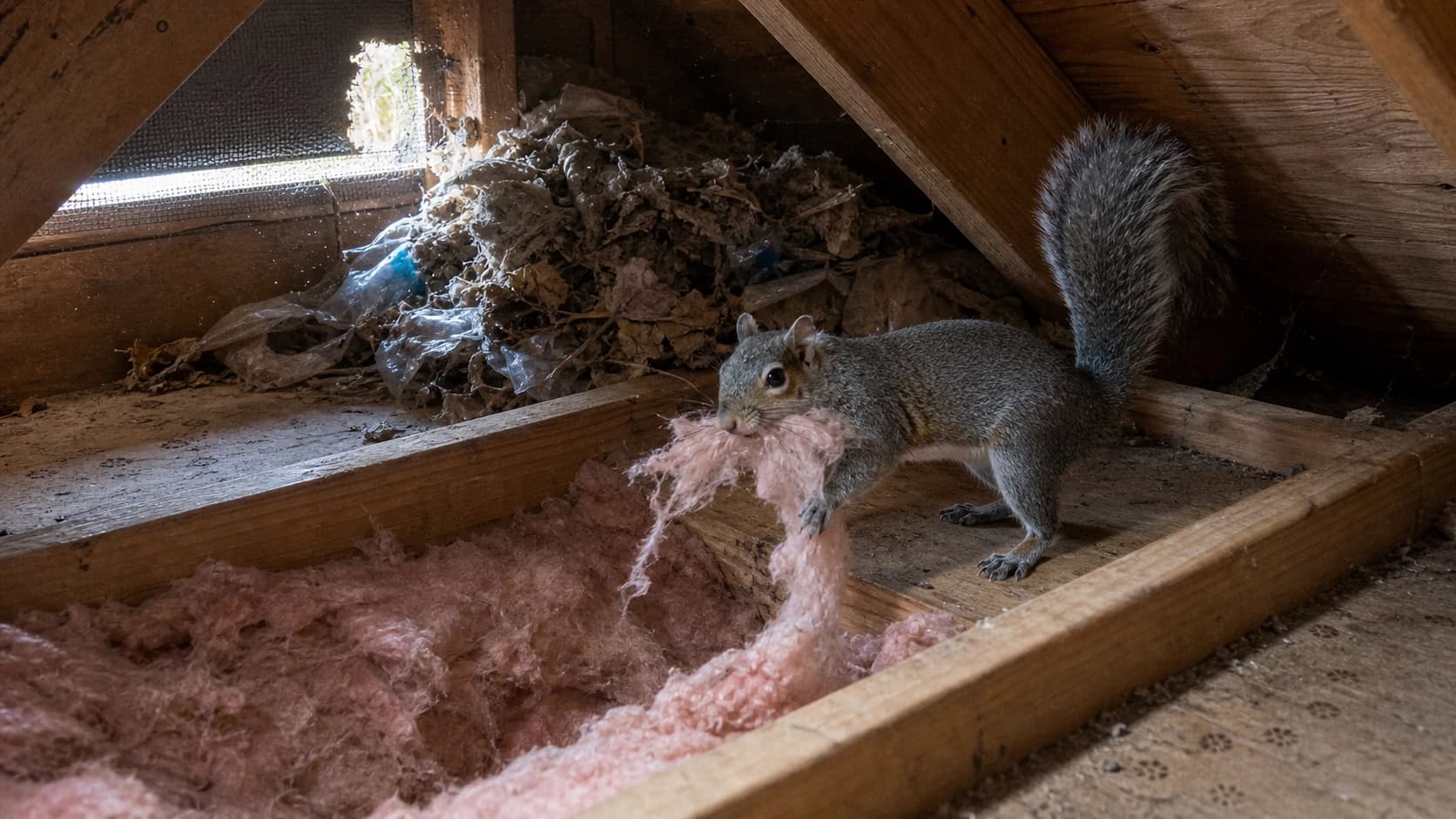
Even if you do remove the squirrel legally, the damage it already caused does not leave with it. Chewed electrical wiring is still a fire hazard. Compressed and contaminated insulation is still underperforming. Droppings and urine are still in the attic. Trapping without inspection, exclusion, and cleanup is solving a third of the problem and calling it done.
What about sealing the holes yourself?
This is where DIY gets genuinely risky. If you seal an entry point while a squirrel is still inside, the animal will chew through interior materials to escape. That means drywall, ceiling panels, and sometimes wiring, creating more damage and more cost than you started with. A panicked squirrel trapped in a wall cavity is not a quiet problem.
The other risk is baby season. Squirrels have two nesting seasons: March through May, and again in September. If you seal the entry point while babies are inside, they cannot survive. You end up with dead animals in the attic, which means odor, flies, and a situation that is significantly worse than the original scratching noise.
If you are going to attempt a seal yourself despite all of the above: use 16-gauge galvanized hardware cloth secured with screws, not staples. Expanding foam, aluminum foil, and plastic mesh will not hold. A squirrel can chew through most off-the-shelf patch materials in under an hour. The material and fastening method matter more than most people expect.
What actually works: the exclusion process
Professional squirrel removal is not really about the squirrel. It is about the building envelope. The process starts with a full exterior inspection to identify every entry point, active and potential. Squirrels often have a primary hole and one or two secondary routes. Missing any of them means the job is not finished.
Once all entry points are mapped, one-way exclusion devices let the squirrels leave but prevent re-entry. After a confirmation period, those devices come off and the openings get permanently sealed with materials rated to withstand animal pressure: galvanized steel, metal flashing, and heavy-gauge hardware cloth. Not foam. Not caulk. Not the hardware store patch kit that lasts until November.
The final step is assessing the attic interior. Squirrels compress insulation, contaminate it with droppings and urine, and chew wiring. If the damage is significant, an attic cleanout and insulation replacement brings the space back to where it should be: clean, properly insulated, and not circulating contaminated air into your living space.
A squirrel that has been in your attic once already knows the layout. If the entry point gets patched with something it can chew through, it will be back, sometimes within hours. Exclusion materials and technique matter more than the trap.
When To Call
Call when you hear daytime scratching or running in the attic. Squirrels are diurnal, so daytime noise is the clearest signal. Other signs include chew marks on the roofline or soffits, droppings in the attic, and insulation that looks disturbed or compressed. If it is March through May or September, assume nesting is involved and act accordingly.
A full inspection produces a plan that closes every entry point, and where the attic already has damage, cleanup is the other side of the job.
