On this page
On this page
- What Drives Attic Insulation Removal Cost in Philadelphia
- Square footage
- Contamination level
- Insulation type and the vermiculite caveat
- Attic access and disposal route
- 2026 Philadelphia Cost Ranges
- Removal-only pricing (no replacement)
- Removal-plus-replacement pricing
- What a Real Quote in Philadelphia Should Include
- Common Philadelphia Contamination Scenarios
- Row homes with shared rooflines
- Older twins with mixed insulation
- Raccoon latrines in attics with finished space below
- Bat guano in older Northwest Philly homes
- DIY vs Professional Insulation Removal in Philadelphia
- What to Watch Out For in Philadelphia Quotes
- Frequently Asked Questions
- How much does it cost to remove rodent-contaminated insulation from a Philadelphia attic?
- Is Philadelphia serviced from a NJ office?
- Why is contaminated insulation removal more expensive than clean removal?
- Can I just leave the contaminated insulation and add new on top?
- What does Pennsylvania law say about rodent-contaminated insulation disposal?
- Is attic insulation covered by homeowners insurance after rodent damage?
- Does insulation need to come out if the rodents are already gone?
- How long does insulation removal take in a typical Philly attic?
- What does an inspection involve?
- Get a Real Number for Your Philadelphia Attic
If you have rodents in the attic, bats in the roofline, or insulation that has been there since the Carter administration and now smells of something it should not, you are probably staring at insulation removal as part of the fix. The number on the proposal usually surprises homeowners more than the wildlife problem that started it.
This guide walks through what attic insulation removal actually costs in Philadelphia in 2026, what drives the cost, and how to read a quote without getting overcharged.
What Drives Attic Insulation Removal Cost in Philadelphia
Three big factors set the number. Everything else is detail.
Square footage
Insulation removal is almost always priced per square foot of attic floor. A 1,000-square-foot attic at $1.80 per square foot is $1,800 of removal labor and disposal. The same attic at $3.60 per square foot is $3,600. Square footage is the first thing the inspector measures.
Philadelphia has a wide spread of attic sizes. Row homes in South Philly, Fishtown, or West Philly often have small attics under 600 square feet. Twins and detached homes in the Northeast or the Northwest can run 1,200 square feet or more. Larger Mt. Airy and Chestnut Hill homes routinely come in over 1,500 square feet of attic floor.
Contamination level
This is the multiplier. The same square footage costs much more to remove if the insulation is saturated with rodent urine, raccoon droppings, or bat guano than if it is just old.
Light contamination, contained to one section of the attic, can stay on the lower end of the cost range. Moderate contamination across most of the attic moves the number up. Heavy contamination, especially raccoon latrine material or bat guano accumulated over years, moves it up significantly because:
- The material has to come out in sealed contractor bags
- The crew works in PPE because of biological hazards (Baylisascaris, histoplasmosis, hantavirus all have documented Philly-area exposure pathways)
- Disposal goes to a facility licensed for biohazard waste, not to the regular dumpster
- The deck below the insulation needs sanitization before new insulation goes in
Insulation type and the vermiculite caveat
The insulation type changes the labor and the disposal:
- Blown-in cellulose is straightforward. HEPA vacuum equipment pulls it out efficiently
- Blown-in fiberglass is similar to cellulose, slightly faster in volume
- Fiberglass batts require physical removal and bagging by hand
- Spray foam rarely needs removal but if it does, removal is significantly more involved
- Vermiculite stops the job. Pre-1990 Philly homes occasionally have vermiculite installed in the attic, and a substantial portion of vermiculite installed in the United States during that era came from a Montana mine that was contaminated with asbestos. Disturbing vermiculite can release asbestos fibers. Vermiculite removal is not a standard insulation job. If the inspection finds vermiculite, the right move is a referral to a licensed asbestos abatement contractor, not removal. The remediation cost for asbestos vermiculite is meaningfully higher than regular insulation removal, but it is the only path that does not contaminate the rest of the house.
The inspection identifies the type before any removal work is scheduled. A contractor who tells you they will vacuum out your vermiculite for a regular insulation removal price is doing something they should not be doing.
Attic access and disposal route
Philadelphia row homes and twins frequently have small attic hatches. The crew has to carry every bag of removed insulation down through the hatch, through the living space, and out to the truck. That is more labor per square foot than a job in a home with a garage attic accessed from the outside.
The disposal route also matters. Clean attic insulation goes to a transfer station like ordinary construction debris. Contaminated insulation goes to a facility that accepts biohazard construction waste. The disposal cost per ton is higher for contaminated material, and the manifesting paperwork takes time.
2026 Philadelphia Cost Ranges
Per-square-foot retail ranges in Philadelphia for 2026. Use these as planning ranges for Philly-area attic jobs; the actual written number comes from the inspection.
Removal-only pricing (no replacement)
| Contamination level | Approximate cost | |---|---| | Light, contained (one section, light rodent activity) | $1.20 to $2.16 per square foot | | Moderate (rodent activity throughout the attic) | $1.80 to $3.00 per square foot | | Heavy (bat guano, raccoon latrine, biohazard disposal) | $3.00 to $5.40 per square foot |
For a 1,000-square-foot attic, that is roughly:
- Light: $1,200 to $2,160
- Moderate: $1,800 to $3,000
- Heavy: $3,000 to $5,400
Removal-plus-replacement pricing
If you are removing the old insulation and installing new in the same job, the per-square-foot retail typically lands in the $3.00 to $6.00 range for blown-in cellulose at R-38 to R-49, and higher for fiberglass batts or higher R-value targets.
For published national 2026 ranges to compare against, the HomeGuide attic insulation removal guide and the Angi attic insulation removal cost article both cover the United States average. Philadelphia tends to fall in the middle to high end of those national ranges because of older housing stock, smaller attic access points, and stricter waste disposal requirements for contaminated material.
What a Real Quote in Philadelphia Should Include
The proposal should write up everything below in detail, with line items, before any work starts:
- Pre-removal inspection findings, with photos of the attic conditions, the contamination, and any structural issues
- The insulation type confirmation
- The contamination class
- The removal protocol (HEPA vacuum, hand removal, or hybrid)
- PPE requirements for the crew
- Disposal class and route
- Sanitization of the attic deck after removal
- Air sealing of penetrations before any new insulation is installed
- New insulation type, R-value target, and per-square-foot install cost (if replacement is part of the job)
- The schedule (one day, two days, or staged)
- The written warranty
- The contractor's NJ HIC registration number
- A current Certificate of Insurance available before any work begins
If the quote is one flat number with no line items, ask for the breakdown. A real Philadelphia attic job has at least the line items above.
Common Philadelphia Contamination Scenarios
The Philly attic mix is different from the NJ suburbs. A few patterns that come up regularly:
Row homes with shared rooflines
In a long row of attached homes, a rodent or wildlife problem that started in one home can move along the shared roofline into adjacent attics. Philly's older row stock often has continuous attic spaces or nearly continuous ones, which means an exclusion job in one home can be incomplete unless the adjacent owners cooperate. This is most common in South Philly, Fishtown, Kensington, and Brewerytown.
Older twins with mixed insulation
Philadelphia twins from the 1920s through the 1960s frequently have insulation that was added in stages. There may be 2 inches of vermiculite from the original construction, 4 inches of blown-in fiberglass added in the 1980s, and another layer of cellulose added in the 2000s. Each layer has to be evaluated. The vermiculite caveat applies.
Raccoon latrines in attics with finished space below
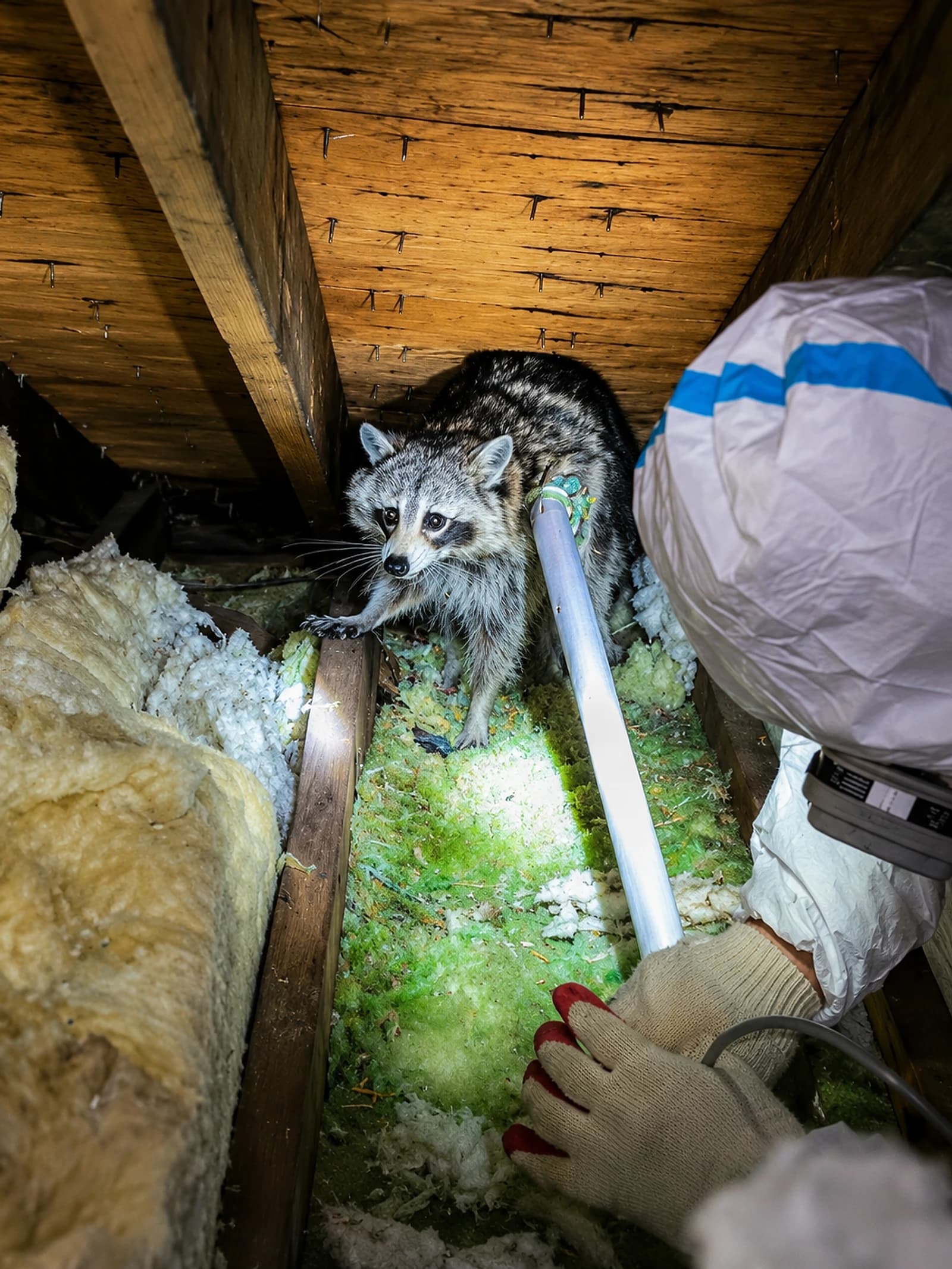
Northeast Philly and the Mount Airy / Chestnut Hill / Manayunk corridor have attics that are sometimes partially finished or used for storage. Raccoon latrine contamination in these attics often soaks into ceiling drywall below, and the cleanup includes drywall replacement in the affected ceiling. That is structural repair, not insulation removal, and it is a separate line on the proposal.
Bat guano in older Northwest Philly homes
Mount Airy, Germantown, and parts of Chestnut Hill have older homes with stone or stucco construction and complex rooflines that bats favor. Long-standing colony situations can produce significant guano accumulation over years, and the cleanup is a biohazard job. NJ Department of Environmental Protection bat-handling rules apply on the NJ side; in Pennsylvania, the Pennsylvania Game Commission has comparable guidance on bat exclusion timing and protected-species protocols.
DIY vs Professional Insulation Removal in Philadelphia
Insulation removal is one of the few attic jobs where DIY can actually save money on a clean, uncontaminated job. A homeowner with a HEPA-rated shop vacuum, proper PPE, and the time to bag and dispose of clean cellulose can do small-scale removal on a single-family attic.
The reasons to call a contractor instead:
- Contamination changes everything. Rodent, raccoon, or bat contamination is biohazard waste. The PPE, the removal protocol, the disposal route, and the sanitization are not DIY territory.
- Vermiculite is non-DIY no matter what. Asbestos exposure is permanent.
- Larger attics with complex structures are unsafe to navigate alone. Falling through ceiling drywall is a documented Philly-area injury pattern.
- Disposal of contaminated insulation requires manifesting paperwork at the licensed facility. A homeowner cannot get rid of biohazard insulation through curbside pickup.
For a clean, single-section, accessible attic, the savings on DIY can be real. For anything else, a contractor is faster, safer, and usually does not cost much more once disposal and time are figured in.
What to Watch Out For in Philadelphia Quotes
A few patterns that should make you pause:
- A flat per-square-foot price quoted before the inspector has been in the attic. Insulation type and contamination are not visible from the curb.
- No mention of vermiculite assessment. Any contractor working pre-1990 Philly housing should be looking for it.
- No PPE specified for contaminated jobs. Tyvek suits, P100 respirators, and goggles are standard for biohazard insulation removal. If the proposal does not mention them, ask.
- No sanitization line item after removal. Removing the insulation without sanitizing the deck below leaves the contamination on the wood. New insulation goes on top of it. The smell comes back in months.
- Promised same-day removal-and-install in one visit. Contaminated removal jobs need ventilation and sometimes drying time before new insulation goes in. A real proposal usually prices the work as one or two days, not one afternoon.
- No HIC number on the proposal. Pennsylvania has its own contractor registration program, and a NJ contractor working in PA should still have a current NJ HIC if the company is NJ-based. Always ask.
Frequently Asked Questions
How much does it cost to remove rodent-contaminated insulation from a Philadelphia attic?
For a moderately contaminated 1,000-square-foot Philly attic, the typical 2026 retail range is $1,800 to $3,000 for removal and disposal alone. Heavy contamination (raccoon latrine, bat guano, severe rodent activity) can push the same attic to $3,000 to $5,400. Replacement insulation is a separate line.
Is Philadelphia serviced from a NJ office?
Yes. Philadelphia and the surrounding PA counties are within the service area, scheduled in the same 24-to-48-hour window as NJ jobs.
Why is contaminated insulation removal more expensive than clean removal?
Three reasons. First, the crew works in full PPE because of biological hazard exposure. Second, the material is bagged in heavy-mil contractor bags and disposed at a facility licensed for biohazard waste, which costs more per ton. Third, the attic deck has to be sanitized after removal, which is its own line item. Light contamination saves on all three. Heavy contamination triggers all three.
Can I just leave the contaminated insulation and add new on top?
You can, but you should not. Contaminated insulation continues to off-gas odors, the contamination spreads as material settles, and any new insulation installed on top traps moisture and bacteria. The contamination has to come out before new goes in.
What does Pennsylvania law say about rodent-contaminated insulation disposal?
Contaminated construction debris in Pennsylvania falls under residual waste regulations enforced by the PA Department of Environmental Protection. Licensed disposal facilities accept biohazard construction waste with the appropriate manifest. A contractor doing this work in PA should be familiar with the disposal route.
Is attic insulation covered by homeowners insurance after rodent damage?
Sometimes. It depends on the policy and the cause of loss. Most policies treat rodent damage as a long-term maintenance issue rather than a covered peril, which means it is excluded. Some policies cover the consequential damage (for example, water damage caused by rodent-chewed pipes) even when the rodent damage itself is excluded. Check with your insurer before assuming coverage.
Does insulation need to come out if the rodents are already gone?
Not always. Light, contained contamination may only need local removal and sanitization. Heavy contamination usually means full or partial removal. The inspection determines what the right work is. Insulation removal is not warranted on jobs that do not need it.
How long does insulation removal take in a typical Philly attic?
A clean removal of a 1,000-square-foot attic usually fits in one day. A contaminated removal with sanitization and follow-up insulation install often runs one and a half to two days. Larger attics or homes with limited access take longer. The schedule is on the proposal.
What does an inspection involve?
A typical inspection in Philadelphia and the surrounding PA counties means a person walking the attic, identifying the insulation type and contamination class, photographing the conditions, and writing up the job before anything is scheduled.
Get a Real Number for Your Philadelphia Attic
The only honest way to put a number on attic insulation removal in Philadelphia is to walk the attic and look. Insulation type, contamination class, attic size, access route, and disposal class all change the cost. An in-person inspection takes the guesswork out of it.
A full insulation removal job covers pre-removal inspection, containment, disinfection, bagged disposal where the contamination calls for it, and a written next-step recommendation.
On this page
On this page
- What Drives Attic Insulation Removal Cost in Philadelphia
- Square footage
- Contamination level
- Insulation type and the vermiculite caveat
- Attic access and disposal route
- 2026 Philadelphia Cost Ranges
- Removal-only pricing (no replacement)
- Removal-plus-replacement pricing
- What a Real Quote in Philadelphia Should Include
- Common Philadelphia Contamination Scenarios
- Row homes with shared rooflines
- Older twins with mixed insulation
- Raccoon latrines in attics with finished space below
- Bat guano in older Northwest Philly homes
- DIY vs Professional Insulation Removal in Philadelphia
- What to Watch Out For in Philadelphia Quotes
- Frequently Asked Questions
- How much does it cost to remove rodent-contaminated insulation from a Philadelphia attic?
- Is Philadelphia serviced from a NJ office?
- Why is contaminated insulation removal more expensive than clean removal?
- Can I just leave the contaminated insulation and add new on top?
- What does Pennsylvania law say about rodent-contaminated insulation disposal?
- Is attic insulation covered by homeowners insurance after rodent damage?
- Does insulation need to come out if the rodents are already gone?
- How long does insulation removal take in a typical Philly attic?
- What does an inspection involve?
- Get a Real Number for Your Philadelphia Attic
