
On this page
On this page
- New Jersey Bat Species: More Than You Think
- Why Timing Is Everything with Bat Exclusion
- The maternity season problem
- The best timing for bat exclusion in NJ
- How Professional Bat Exclusion Works
- The one-way device process
- Methods That Don't Work (and Make Things Worse)
- The Health Risks of Bat Colonies in Your Attic
- What to Do If You Find Bats in Your Attic
- Step 1: Observe and document
- Step 2: Call for a professional inspection
- Step 3: Handle bats in living spaces carefully
- Step 4: Do not attempt DIY fixes
- Choosing a Bat Exclusion Professional in NJ
- The Short Version
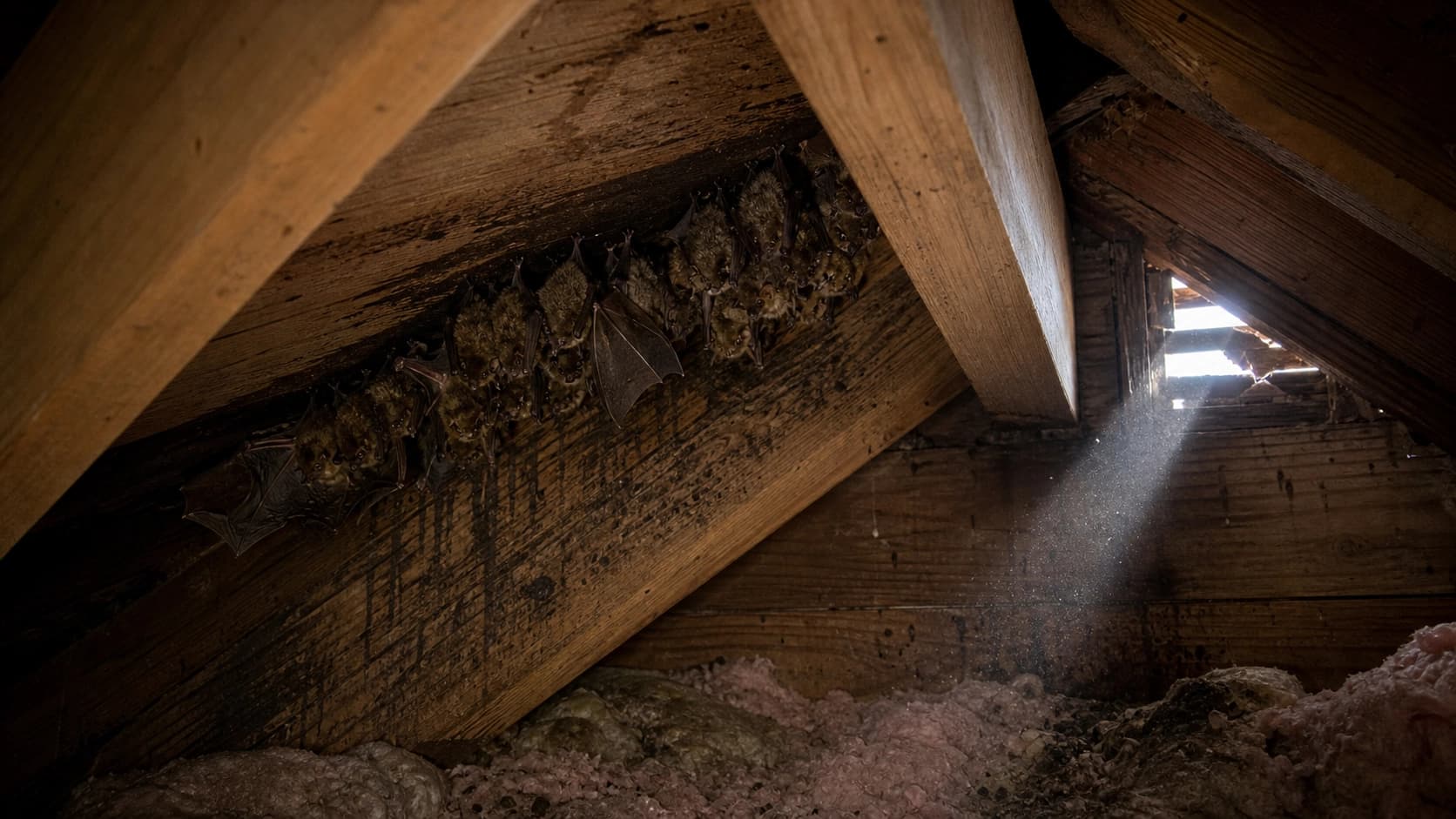
Finding bats in your attic is one of those situations where the first instinct, grab a broom and start swinging, is exactly the wrong move. Bats are colonial animals. Where there is one, there are usually dozens or hundreds. And the damage they cause accumulates fast: guano piling up, ammonia fumes, health risks, stained ceilings, and contaminated insulation.
The good news is that professional bat exclusion works permanently when done correctly. The bad news is that timing, technique, and thoroughness all matter enormously. Get any of them wrong and you are right back where you started, or worse.
Bat exclusion projects throughout New Jersey range from older colonial homes in Bergen County to Victorian-era houses in Cape May. This guide covers everything a NJ homeowner needs to know before taking action.
New Jersey Bat Species: More Than You Think
New Jersey is home to nine documented bat species. That surprises most homeowners, who tend to think of bats as a rural or tropical concern. In reality, NJ's mix of suburban neighborhoods, forested areas, and waterways creates ideal bat habitat from the Delaware Water Gap down to the Pine Barrens.
The nine species found in New Jersey are:
- Big brown bat (Eptesicus fuscus): the most common species found in homes, year-round resident
- Little brown bat (Myotis lucifugus): once extremely common, populations declining due to white-nose syndrome
- Northern long-eared bat (Myotis septentrionalis): uncommon, primarily found in forested areas
- Indiana bat (Myotis sodalis): rare, primarily found in the northwestern part of the state
- Eastern small-footed bat (Myotis leibii): small and uncommon
- Silver-haired bat (Lasionycteris noctivagans): migratory, rarely found in buildings
- Eastern red bat (Lasiurus borealis): tree-roosting, usually does not enter homes
- Hoary bat (Lasiurus cinereus): NJ's largest bat, migratory and uncommon
- Tri-colored bat (Perimyotis subflavus): small, increasingly rare
Of these nine species, the big brown bat is by far the one most likely to be living in your attic. They are adaptable, cold-tolerant, and genuinely prefer buildings over natural roosts. If you have bats, there is a very strong chance they are big browns.
You cannot always tell species apart without close examination. A little brown bat looks quite similar to a big brown bat at a glance, especially when you are staring up at your roofline at dusk trying to count how many are flying out. A professional can identify the species and recommend the right approach.
Why Timing Is Everything with Bat Exclusion
This is the single most important thing to understand about bat removal. There is a window during the year, May 1 through July 31, when exclusion will backfire badly. Those are the dates in the NJ Division of Fish and Wildlife's nuisance wildlife control guidelines for bats, which direct that no exclusions from roosts be conducted during that period and that exclusion work happen only from April 1 to April 30 or August 1 to October 15.
The maternity season problem
During late spring and summer, female bats gather in colonies to give birth and raise their young. Baby bats (called pups) are born in late May or June. For the first several weeks of life, pups cannot fly. They cling to the roost, completely dependent on their mothers for warmth and food.
If you install exclusion devices during this period, the adult bats leave to feed at night and cannot get back in. The pups, unable to fly, are trapped inside. They die in your walls and attic, creating horrible odors, attracting insects, and posing health risks. It defeats the entire purpose of the exclusion, and you end up paying for the job twice.
The best timing for bat exclusion in NJ
| Time Window | Recommendation | Why |
|---|---|---|
| Aug 1 to Oct 15 | Ideal | Pups fly independently, comfortable margin before hibernation |
| April | Second best | Before maternity colonies form, but tighter margin |
| May 1 to Jul 31 | Do NOT exclude | Flightless pups get trapped inside, creating worse problems |
| Oct 16 to Mar 31 | Restricted | Bats may overwinter in buildings; exclusion only if surveys confirm they are absent |
If you discover bats in your attic in June or July, the smart move is to get your inspection and quote done now so you are ready to act the moment the timing is right. Rushing exclusion during maternity season is how people end up with dead bats in their walls and a second bill to fix the first attempt.
How Professional Bat Exclusion Works
There is only one approach that actually works for bat removal: live exclusion using one-way devices. Poison does not work. Trapping does not work for colonies. Sealing them inside is a disaster. One-way exclusion is the method that gets lasting results.
The one-way device process
A one-way device is exactly what it sounds like. It is a tube, cone, or netting arrangement installed over a bat entry point that allows bats to exit but blocks re-entry. When bats leave at dusk to feed (and they do leave every night), they pass through the device, fly off to hunt, and when they return, they cannot get back inside. Over the course of a few days to two weeks, the entire colony exits.
The process for a professional bat exclusion typically involves:
- Inspection: A thorough survey of the entire structure to identify all entry points. Bats can squeeze through gaps as small as 3/8 of an inch. This step cannot be rushed.
- Sealing secondary entry points: Every gap, crack, and opening that bats could use gets sealed, except for the primary entry/exit points.
- Installing one-way devices: These go over the primary entry points where bats are actively entering and exiting.
- Monitoring period: The devices stay in place for a minimum of several days (at least a week is recommended) to ensure all bats have departed.
- Final sealing: Once the colony has fully exited, the one-way devices are removed and the remaining entry points are permanently sealed.
- Cleanup: Guano removal, insulation replacement if contaminated, and sanitization as needed.
Done correctly, not a single bat is harmed in this process. They simply relocate to natural roosting sites like tree cavities, rock crevices, and bat houses.
Methods That Don't Work (and Make Things Worse)
Professionals regularly arrive at homes where someone has already tried one of these approaches, and the situation has gone from manageable to genuinely problematic.
There is only one approach that actually works for bat removal: live exclusion using one-way devices.
- Poison or chemicals: There are no effective pesticides for bats. Mothballs, rodenticides, and chemical foggers do not drive bats out. They contaminate your living space and create a health hazard for your family.
- Glue traps: Cruel and ineffective for colonies. You might catch one or two bats while the other 150 continue roosting.
- Sealing bats inside: Plugging holes while bats are still in your attic is not exclusion. It is entombment. The bats will die inside your walls, or they will find their way into your living space looking for another exit. Homeowners who sealed the exterior have ended up with bats flying through their bedroom.
- Ultrasonic devices: Do not work. Bats use echolocation. They are literally built to navigate sound. A cheap plug-in device from Amazon is not going to outsmart millions of years of evolution.
- DIY exclusion: Bats use entry points that are extremely difficult to find without experience. Missing even one gap means the colony re-enters. A handyman who seals 90 percent of the entry points leaves a job that sounds good until you realize the bats just moved to the openings that were missed.
The Health Risks of Bat Colonies in Your Attic
Bats themselves are not especially dangerous. The real problem is what they leave behind.
A colony of 150 big brown bats (a common colony size in NJ attics) produces massive quantities of guano every summer. Bat guano harbors the fungus that causes histoplasmosis, a respiratory infection that can be serious, especially for children, the elderly, and anyone with a compromised immune system.
Beyond histoplasmosis, bat guano accumulation causes:
- Stained ceilings and walls from urine seeping through
- Strong ammonia odors that permeate living spaces
- Insulation contamination that reduces energy efficiency
- Structural damage from the weight and acidity of guano buildup
- Attraction of secondary pests like bat bugs and beetles
The rabies concern is real but proportionate. In New Jersey, a small percentage of bats tested each year come back positive for rabies. That rate is higher than the general population because sick bats are more likely to end up in contact with humans, but it underscores why any potential contact should be taken seriously. If a bat gets into your living space and there is any chance it had contact with a person or pet (especially someone who was sleeping), contact your local health department.
What to Do If You Find Bats in Your Attic
If you have confirmed or strongly suspect bats in your attic, here is the practical step-by-step:
Step 1: Observe and document
Go outside at dusk (about 20 minutes after sunset) and watch your roofline. Bats exit in a distinctive pattern, dropping from their roost and taking flight. Count how many you see and note where they are exiting from. This information is extremely helpful for a professional inspection.
Step 2: Call for a professional inspection
Even if the timing is not ideal for exclusion, a professional inspection gives you critical information: how many bats, which species, where they are entering, what condition the attic is in, and what the job will involve. This way you are ready to move quickly when the timing is right.
Step 3: Handle bats in living spaces carefully
If a bat gets into your bedroom, living room, or another occupied area of your home, close the room off from the rest of the house and open a window. Most bats will find the opening and leave on their own within minutes. If the bat does not leave, or if there is any chance the bat had contact with a person or pet, contact your local health department. Rabies testing may be recommended, and the bat should be captured if possible without harming it.
Step 4: Do not attempt DIY fixes
This point cannot be stressed enough. Bat exclusion requires finding every single entry point, and bats can squeeze through a gap the width of a dime. Sealing 90 percent of the holes just moves the colony to the ones you missed. And incorrect exclusion during the wrong time of year means dead bats in your walls, which is a worse problem than live bats in your attic.
Choosing a Bat Exclusion Professional in NJ
When evaluating bat removal companies, ask these questions:
- Do you use one-way exclusion devices? (If they mention trapping the colony or using chemicals, walk away.)
- Are you licensed and insured for wildlife work in New Jersey?
- How is coverage handled on exclusion work? (Good companies explain the work and any service-specific coverage in writing.)
- Do you handle guano cleanup and insulation replacement? (This is an important part of the job.)
- How many entry points do you typically find on a home like mine? (Experience shows. If they say "just one or two," they probably are not looking hard enough.)
A good professional will assess the situation, identify the species, show you the entry points, and give you a clear plan with honest pricing. If the timing needs to be adjusted, a reputable company will say so and schedule accordingly. Doing the job right in September beats doing it wrong in June.
The Short Version
Bat exclusion works, permanently, when it is done with the right technique and the right timing. One-way devices let the colony leave safely, then you seal every entry point so they cannot return. Get the timing wrong (especially during maternity season) and you end up with dead bats in your walls and a much bigger problem.
Poison does not work. DIY sealing does not work. Ultrasonic gadgets definitely do not work. Professional one-way exclusion with thorough sealing is the only approach that gets lasting results.
Fluttering in the walls, small droppings in the attic, or bats flying out of the roofline at dusk are all signs it is time to consult a licensed wildlife professional about the right approach for the specific situation.
On this page
On this page
- New Jersey Bat Species: More Than You Think
- Why Timing Is Everything with Bat Exclusion
- The maternity season problem
- The best timing for bat exclusion in NJ
- How Professional Bat Exclusion Works
- The one-way device process
- Methods That Don't Work (and Make Things Worse)
- The Health Risks of Bat Colonies in Your Attic
- What to Do If You Find Bats in Your Attic
- Step 1: Observe and document
- Step 2: Call for a professional inspection
- Step 3: Handle bats in living spaces carefully
- Step 4: Do not attempt DIY fixes
- Choosing a Bat Exclusion Professional in NJ
- The Short Version
