
On this page
On this page
- What Drives Bat Removal Cost
- Colony Size
- The Number of Entry Points
- Roofline Complexity
- Timing of the Work
- Cleanup of Affected Material
- What Affects the Price
- What Should Be Included in a Professional Bat Removal
- DIY vs Professional: An Honest Comparison
- When DIY Might Work
- When DIY Won't Work
- Red Flags in Bat Removal Pricing
- The Real Cost of Waiting
- Get a Straight Answer
The short answer
Bat removal cost in New Jersey runs from $300 to $1,800 for the exclusion portion alone, with $480-$2,400 added for guano cleanup. Published 2026 ranges from HomeGuide overlap the lower end of that spread. Bat work in NJ is exclusion with a one-way device, never poison or traps. Exclusion schedules around maternity season (roughly May through July) because sealing then would trap flightless pups inside. Older Shore stock in towns like Asbury Park, Belmar, and Long Branch sees the most bat work because the construction style is built for it.
What matters most
- What gets sold as bat extermination is really exclusion: a one-way device lets the colony out, a permanent seal keeps it out
- Maternity season (roughly May through July) blocks exclusion, flightless pups would die inside
- Bats squeeze through gaps as small as 3/8 inch; standard rodent exclusion materials are sometimes too coarse
- Histoplasmosis spores in accumulated guano are real, DIY cleanup without PPE is genuinely dangerous
- A bat in the living space with possible human contact during sleep is a rabies-protocol scenario for the local health department, not a wildlife contractor
What a real job includes
- Roofline inspection with photos of every potential entry, including dusk emergence observation
- Species identification when possible
- Timing decision against NJ maternity season
- One-way device installation at the active entry (typically 7-14 days)
- Permanent sealing with stainless steel mesh sized smaller than 3/8 inch
- Sealing every other potential entry on the building envelope
- Guano cleanup with HEPA-vacuum equipment, full PPE, sealed biohazard disposal
- Insulation removal where guano accumulated heavily
- Written warranty
What not to do
- Don't seal entries during NJ maternity season (May through July)
- Don't try to clean dry guano without PPE, histoplasmosis exposure
- Don't pay for poison or fogging for bats, it leaves carcasses in your walls; the job that works is exclusion and permanent sealing
- Don't release a bat that may have had human contact during sleep, capture without crushing, call local health department
- Don't accept foam-only sealing, gaps as small as 3/8 inch matter for bats
If you've spotted a bat in the house, watched what looked like birds streaming out of your chimney at dusk, or found a scatter of small dark droppings under the eaves (the lower edge of your roof where it overhangs the wall), you're already past the question of whether you have bats. The next question is what it's going to take to get them out for good.
The honest answer is that bat removal cost depends on factors that can only be assessed during an in-person roofline inspection. An inspection is what reveals exactly what's up there before any money is spent. Here's what drives the price of a bat job and what a thorough exclusion should include.
What Drives Bat Removal Cost
Every roof is different. A small colony in a single soffit gap (the underside of your roof overhang) on a one-story Cape is a very different job than a large colony with multiple entry points along a multi-level Colonial. Here are the main factors that determine the price.
Colony Size
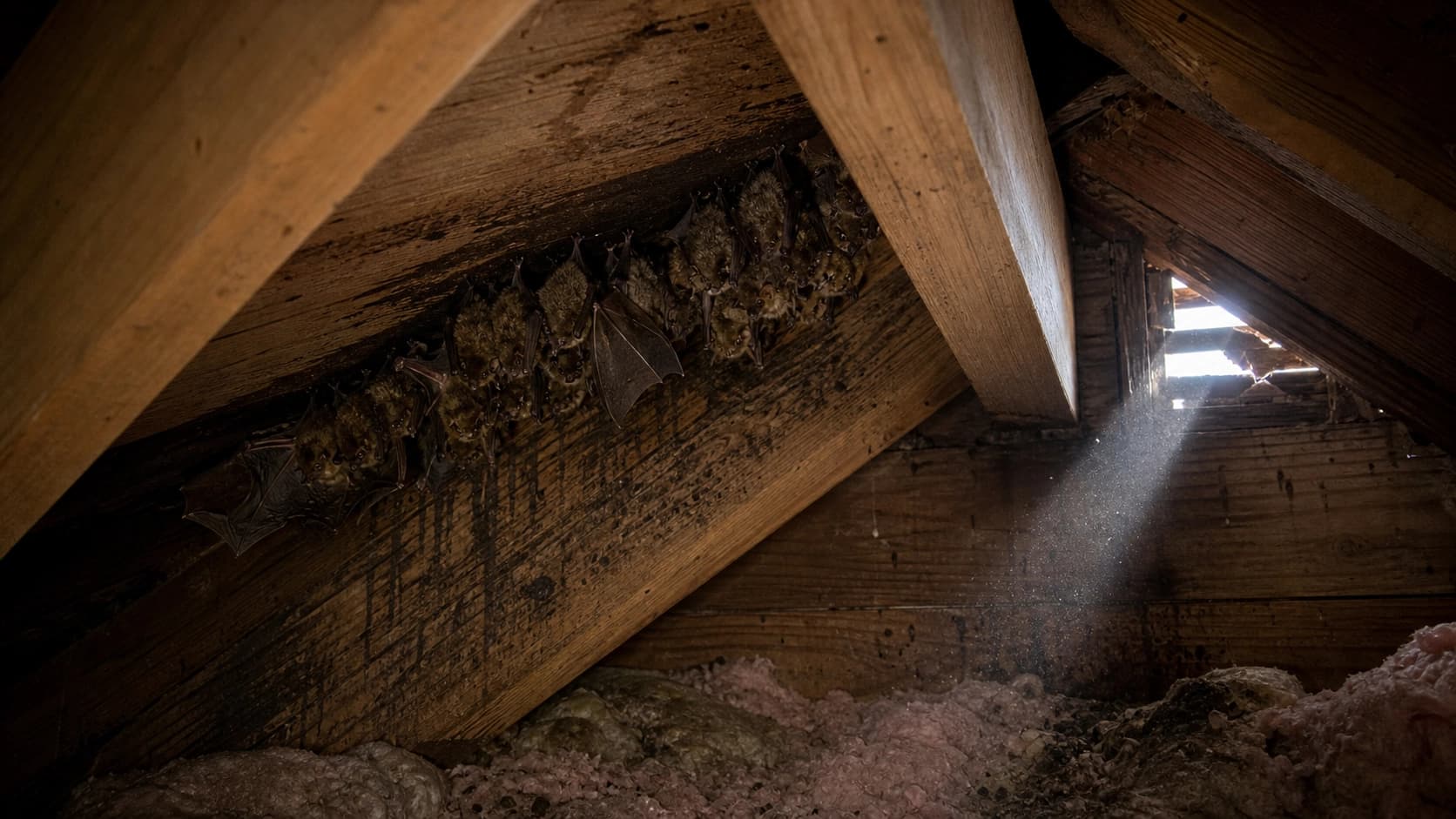
Bats are colonial. Where there is one bat, there are usually dozens. A handful of bats living in a single corner of an attic is the smaller end of the work. A maternity colony of fifty or more bats in the rafters (the wood frame holding up your roof) is significantly larger, both because the active exit-and-monitor phase takes longer and because the cleanup component grows with the colony.
The biggest predictor of colony size is how long the bats have been there. A colony that moved in last summer is much smaller than a colony that has been raising pups in your attic for five years. Long-term colonies produce a lot of guano, and that guano changes the rest of the job.
The Number of Entry Points
Bats can squeeze through gaps as small as 3/8 of an inch. That means soffit lifts, ridge cap separations (the cap at the peak of your roof coming apart), gable vent failures, gaps where flashing (the metal sealing strip between roof sections) meets shingles, and even small openings around chimney bricks all qualify as bat doors. Most homes with bats have more than one. The visible gap a homeowner notices is rarely the only one.
A roof with one confirmed exit and a handful of small secondary openings is on the lower end. A roof with multiple active exits along three sides of the structure is significantly more work. Every potential opening has to be either confirmed inactive or sealed permanently. Missing one means the colony comes right back in.
Roofline Complexity
A single-story ranch with a simple gable roof and accessible eaves is the easier version. A three-story Colonial with multiple dormers, a complicated valley (where two roof slopes meet), a wraparound soffit, and a steep pitch is a lot more work, even with the same number of bats. Higher work requires ladders, fall protection, and sometimes scaffolding. Complex rooflines mean more places to inspect, more places to seal, and more time on the structure.
Older homes (Victorians, multi-story farmhouses, large center-hall Colonials common across North Jersey) almost always have more entry points than a homeowner expects. The roofline complexity is doing as much to drive the price as the bats themselves.
Timing of the Work
This is the factor most homeowners don't realize matters. NJ bat maternity season runs roughly May through July. During those weeks, female bats are giving birth and nursing pups that cannot fly yet.
If exclusion happens during maternity season, the one-way devices let the adult females out but trap the flightless pups inside. The pups die in the rafters. The smell takes weeks. Adult bats trying to get back to their pups become more aggressive about finding alternate routes, including into the living space. The repair work balloons. What would have been a routine exclusion turns into a much bigger problem.
Inspections happen any time of year. The exclusion itself is timed to when the colony can leave on its own without leaving young behind. A homeowner who calls in April to schedule a June job sometimes hears that the actual exclusion will need to wait until August. That is not a delay tactic. That is the job being done correctly.
Cleanup of Affected Material
Bats produce guano, and a long-term colony produces a lot of it. Guano is not just unpleasant. It carries histoplasmosis spores when it dries out and gets disturbed, which is a real respiratory health concern. It also soaks into and ruins fiberglass insulation underneath wherever the colony has been hanging.
A small colony that has been in the attic for a year leaves a manageable mess. A long-term colony of fifty bats over five years leaves a heavy guano accumulation, soaked-through insulation, and stained roof decking (the plywood your shingles are nailed to). Light, dry guano in trace amounts can stay in many cases. Heavy or saturated material should come out as part of the job.
The roofline inspection tells you whether cleanup belongs in the bat job or whether it is a separate conversation. Some bat jobs end at the seal-up. Others continue into a full attic restoration because the insulation is genuinely beyond saving.
What Affects the Price
The factors that move a bat job from a smaller one to a bigger one:
- Colony size: A few bats versus a maternity colony of fifty changes the work substantially.
- Number and location of entry points: One soffit gap is faster than five gaps spread across two sides of the roof.
- Roofline complexity and height: Single-story ranch versus multi-level Colonial. Simple gable versus complex valleys and dormers.
- Length of occupation: A colony that moved in last spring versus a colony that has been there since 2018. Length drives the cleanup work as much as the removal.
- Cleanup of affected insulation: Trace amounts can usually stay. Heavy concentrations or visibly soaked insulation should come out.
- Season: Inspection any time. Exclusion respects maternity season (May through July in NJ). Outside those months the work is straightforward.
- Architectural complications: Solar panels, recent roof work, gutter guards, and finished or insulated ceilings underneath the attic can all change the access plan.
What Should Be Included in a Professional Bat Removal
A real bat exclusion in New Jersey is not a quick afternoon visit. A thorough quote should include all of the following, in writing, before any work starts:
- Whole-roof inspection. Every potential entry point gets identified and photographed, not just the one you noticed.
- Active-exit confirmation. The opening the colony is actually using right now is the one that gets closed last. Sealing the wrong gap traps the colony inside.
- One-way exclusion devices sized to the gaps and installed at the correct angle so bats can leave at dusk but cannot return.
- Living-space pathway closures so bats cannot drop down into bedrooms while the exclusion is running.
- Confirmation the colony is out before the active exit gets permanently sealed.
- Permanent quarter-inch steel hardware cloth on the closure, screwed (not stapled), sealed for outdoor weather. Foam and caulk do not last a winter.
- A walk-through with photos at the end so you see the closed gap, the attic deck, and the existing insulation condition before anything else gets recommended.
- Cleanup recommendations only when the attic actually calls for it. Light, dry guano in trace amounts can stay. Heavy guano, soaked insulation, or affected decking gets a written cleanup plan with photos.
If the quote covers "trapping bats" or "killing bats" or only sealing the one gap visible from the ground, that is not the right approach. Bats are protected under New Jersey wildlife law. The legal and effective approach is exclusion, not extermination.
DIY vs Professional: An Honest Comparison
When DIY Might Work
If you have a single bat that flew in through an open window and is trapped inside the living space, you can usually get it out yourself. Open a window or door to the outside, close interior doors to contain the bat in one room, dim the lights inside, brighten the outside, and most healthy bats will find their way out within a few minutes. This is not bat removal. This is one bat that took a wrong turn.
When DIY Won't Work
For an actual bat colony in your attic, DIY is almost always a worse outcome. The reasons are technical, not promotional.
You cannot identify the active exit reliably without watching the structure at dusk over multiple evenings during the right months. You cannot install one-way exclusion devices safely on a steep roof without fall protection. You cannot legally relocate or kill bats in NJ. You cannot clean guano safely without proper PPE because of histoplasmosis exposure risk. And every gap you miss is an open door, so the colony comes back in within weeks.
The most common DIY outcome is a homeowner who seals the obvious gap with foam in July, traps the colony inside, and calls a professional in August once the smell starts. That work is more expensive, takes longer, and requires more cleanup than just doing the exclusion correctly the first time.
Red Flags in Bat Removal Pricing
A few warning signs that a quote is the wrong shape, regardless of the dollar amount:
- No roofline inspection. Anyone giving a quote without walking your roof is guessing. Bats live above the soffit. The inspection has to happen up there.
- The quote covers "trapping bats." Bats are not trapped. They are excluded. Trapping is illegal for native NJ bats and would not solve the entry-point problem anyway.
- The quote only covers the one gap you noticed. Bats use multiple gaps. Sealing one and missing the others is not a solution.
- Foam and caulk listed as the closure material. Neither survives a winter on a steep roof. Quarter-inch galvanized steel hardware cloth, screwed and sealed for the exterior, is what lasts.
- Same-day exclusion during maternity season. May through July in NJ, exclusion has to wait. A company that promises immediate exclusion in those months is either inexperienced or willing to trap nursing pups in your attic, which becomes your problem fast.
- No written estimate before work starts. Verbal quotes drift. Written ones hold.
The Real Cost of Waiting
Bat colonies grow. Every year a maternity colony returns to the same attic, the population gets larger and the guano accumulation gets deeper. A two-bat problem in 2023 is a fifteen-bat problem by 2026 if it goes unaddressed. The exclusion work grows with the colony. The cleanup grows even faster.
There is also a structural issue. Long-term guano saturation damages roof decking. Urine staining works its way into rafters. Insulation beneath the colony becomes a write-off. None of that is reversible. Every year of delay turns a routine exclusion into a partial restoration.
And there is the health consideration. Histoplasmosis exposure happens when dried guano gets disturbed, which can happen with attic foot traffic, HVAC airflow disturbing the attic, or storm-related activity. The longer the colony has been there, the more guano there is, and the more chances for exposure.
A small colony caught early is a routine exclusion. A long-term colony with multiple entry points and a heavy guano load is a much bigger conversation. The approach is the same either way. The difference is the size of the job.
Get a Straight Answer
The only honest way to arrive at a real number on bat removal in NJ is to walk the roof and look. Photo evidence of the active exit, count of likely entry points, attic condition, and timing of the work all change the price. An in-person inspection takes the guesswork out of it.
A proper bat job is humane one-way exclusion plus a permanent steel-mesh seal.
On this page
On this page
- What Drives Bat Removal Cost
- Colony Size
- The Number of Entry Points
- Roofline Complexity
- Timing of the Work
- Cleanup of Affected Material
- What Affects the Price
- What Should Be Included in a Professional Bat Removal
- DIY vs Professional: An Honest Comparison
- When DIY Might Work
- When DIY Won't Work
- Red Flags in Bat Removal Pricing
- The Real Cost of Waiting
- Get a Straight Answer
