
On this page
On this page
- What Drives Raccoon Removal Cost
- Whether There Are Kits in the Attic
- Number of Entry Points
- Roofline Complexity and Attic Damage
- Latrine Cleanup and Baylisascaris
- Sealing the Entry Points
- Baby Season Changes the Job
- What Should Be Included in a Professional Raccoon Removal
- DIY vs Professional: An Honest Comparison
- Red Flags in Raccoon Removal Pricing
- The Real Cost of Waiting
- FAQs
- How much is raccoon removal in NJ on a typical job?
- Does the cost change if there are baby raccoons?
- Are raccoons protected in New Jersey?
- What is a raccoon latrine and why does it matter for cost?
- What's the difference between raccoon removal and raccoon damage repair?
- Can I just trap the raccoon myself?
- How long does a raccoon removal job take?
- What if I already sealed the entry?
- Get a Straight Answer
The short answer
Raccoon removal cost in New Jersey runs from a few hundred dollars on a clean single-raccoon eviction to several thousand once latrine cleanup and contaminated insulation removal are added. Published 2026 ranges from HomeGuide list $200-$300 for single-raccoon removal and $500-$1,500 for animal-in-attic work; Angi lists $150-$300 per animal plus cleanup and repair. NJ tends to fall in the middle to high end because of older housing stock. The biggest cost driver is whether kits are in the attic during NJ maternity season (mid-March through July). A maternity-den eviction with kit hand-removal, and Baylisascaris-aware latrine cleanup can run $2,400-$6,000+.
What matters most
- NJ raccoon baby season is mid-March through early May with late litters through July
- Sealing the entry while kits are inside kills them, most expensive mistake homeowners make
- Latrine cleanup with Baylisascaris-aware handling is required on roughly half of NJ raccoon work
- Latrines that soaked through the ceiling add cleanup scope
- Older NJ housing stock typically falls in the middle to high end of published 2026 ranges
What a real job includes
- Roofline walk-around with photos of every potential entry
- Confirmation of whether kits are present
- Hand-removal of kits where applicable, reuniting with mother outside
- One-way device installation timed to the kit situation
- Permanent sealing with quarter-inch galvanized steel hardware cloth (foam alone won't hold)
- Latrine cleanup with HEPA equipment, full PPE, sealed biohazard disposal
- Insulation removal where contamination is heavy
- Drywall replacement on ceilings affected by latrine soak-through
- Fascia, soffit, roof return rebuild where damaged
- Written warranty
What not to do
- Don't seal the entry without checking for kits
- Don't try to trap and relocate a raccoon yourself, if she has kits in the attic you have just orphaned them inside your ceiling
- Don't try to clean a raccoon latrine without PPE, Baylisascaris roundworm eggs are documented
- Don't accept "trap-and-go" without permanent exclusion, new raccoons rotate through the same hole
- Don't accept foam-only sealing, raccoons rip foam apart
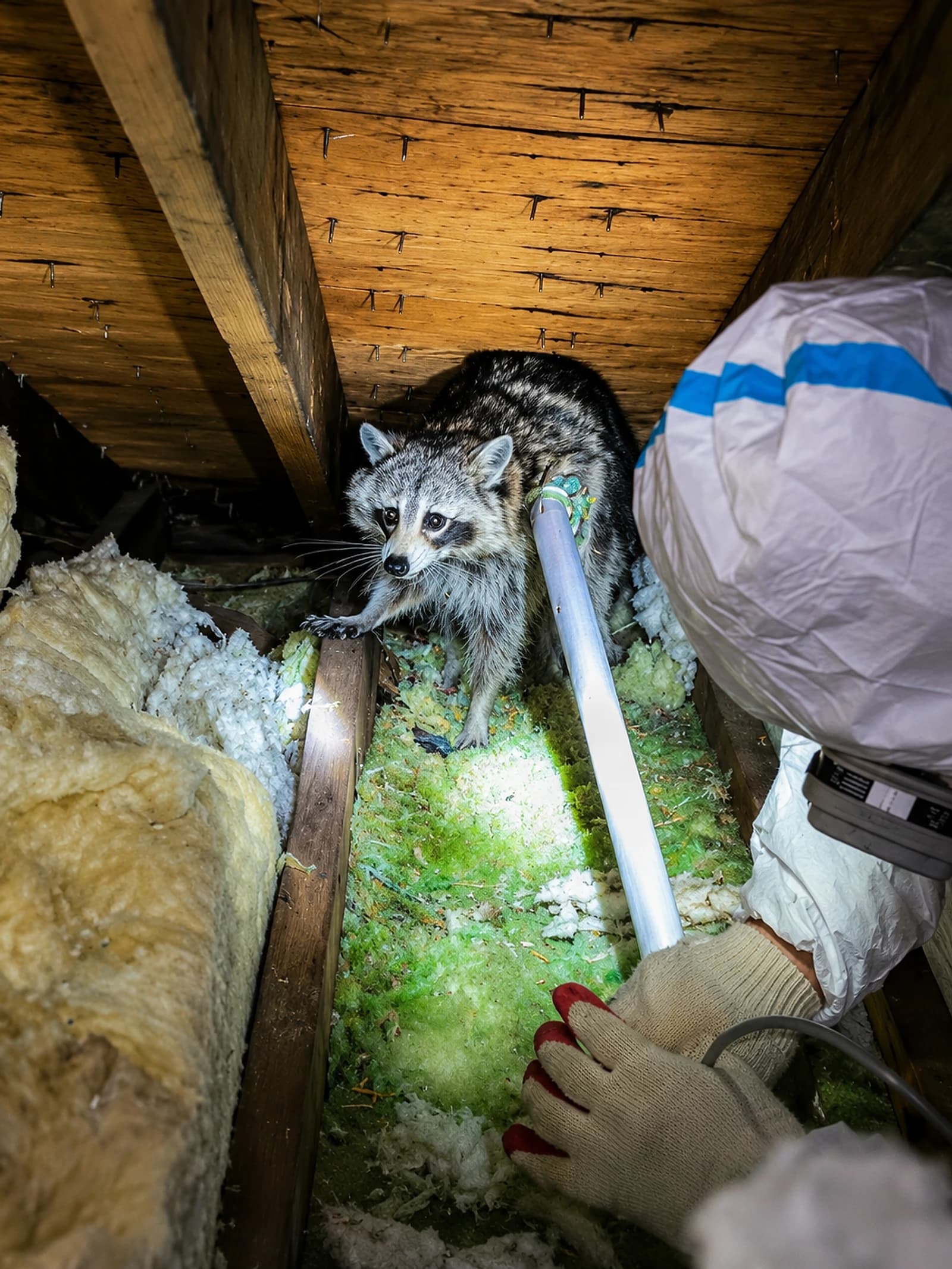
If something woke you up at 3 AM that sounded less like a rat and more like a small wrestler in the attic, you almost certainly have a raccoon. Raccoons are the largest and loudest of NJ's attic invaders, and they do not tiptoe.
Once you know what's up there, the next question is what it's going to take to get the raccoon out and put your attic back together. The honest answer is that raccoon removal cost depends on factors that can only be assessed during an in-person inspection. An in-person inspection is the only way to know what you're dealing with before you spend anything. Here's what drives the price and what a thorough job should include.
What Drives Raccoon Removal Cost
Every raccoon job is a little different. Two homes a block apart in Morris County or Bergen County can have wildly different prices depending on what the raccoon has been doing up there.
Whether There Are Kits in the Attic
This is the first question to settle, and it's the question that changes everything else. Female raccoons in NJ are looking for warm attic space to give birth and raise kits. The window runs roughly March through July.
When kits are present, the job is not "evict the raccoon." The job is locate the kits, remove them by hand, reunite them with the mother outside in a way that triggers her to relocate them on her own, then close the entry. Kits cannot be trapped. They cannot fly out a one-way device. They cannot be left behind, both because that's inhumane and because a flightless kit dying in the rafters (the wood frame holding up your roof) becomes a weeks-long odor problem.
Hand-removal of kits adds time and often adds a return trip. A solo male raccoon evicted with a one-way door is on the smaller end of the work. A mother with a litter of four in the back corner of a finished attic is significantly more involved.
Number of Entry Points
Raccoons are strong enough to make their own door. A weak fascia board (the trim board along the roof edge), a soffit corner (the underside of your roof overhang) that's already lifting, a roof vent with a flimsy screen, a chimney without a cap. They'll exploit what they find and they'll enlarge it.
A roof with one obvious entry is the cleaner version. A roof where the raccoon has been pushing in at one spot and out at another (very common with mothers prepping escape routes), or where the homeowner sealed one gap and the raccoon just opened a second one, is more work. Every potential opening has to be either confirmed inactive or sealed permanently. Missing one means the raccoon comes right back.
Roofline Complexity and Attic Damage
A single-story ranch with accessible eaves (the lower edge of your roof where it overhangs the wall) is the easier version. A multi-level Colonial with dormers, a complicated valley (where two roof slopes meet), and a steep pitch is more work even with the same number of raccoons. Older homes across Bergen, Essex, and Union counties almost always have more vulnerable points along the roofline than a homeowner expects.
Raccoons cause the most attic damage of any NJ wildlife species. They tunnel through blown insulation to make dens, tear up batt insulation, push aside ductwork, crush ceiling drywall under their weight, and will absolutely chew on wood and wire. A raccoon that moved in last week leaves a manageable mess. A raccoon that has been raising kits up there for two months has hollowed out a den, soiled a wide area, and likely damaged ductwork or insulation.
Latrine Cleanup and Baylisascaris
This is the part most homeowners don't know about until it's their problem. Raccoons designate a single spot in the attic as a latrine and use it repeatedly. A latrine is a concentrated pile of feces and urine that soaks into insulation, into ceiling drywall from above, and sometimes through to the framing. It is not "a few droppings." It is a saturated, hazardous spot that needs to come out.
Raccoon latrines are also where Baylisascaris procyonis, the raccoon roundworm, lives. The eggs are highly resistant, aren't killed by typical disinfectants, and can stay viable for years. Inhaling or touching contaminated material and then your face is a real human health concern, especially for kids.
Done correctly, latrine cleanup means the affected insulation comes out, the roof decking (the plywood under your shingles) gets HEPA-vacuumed and treated with the right products, and disposal happens in sealed bags that don't disturb the eggs. A small latrine that formed over a couple of weeks is a contained job. A latrine used by a mother and growing kits over three months is a much bigger sanitation job.
Sealing the Entry Points
Raccoons damage what they enter. The hole pushed through the soffit needs to be properly closed. The fascia they pried up needs to be re-secured. The vent screen they tore needs replacing. The chimney they came down needs a proper cap. A small gap the raccoon turned into a fist-sized opening gets closed with materials that hold.
The sealing work is what most people are surprised by, because the raccoon was the dramatic part but the seal-out is where the dollars accumulate.
Baby Season Changes the Job
If you're calling between March and July, the kit question comes first. The eviction has to be timed and handled around the kits. A one-way device should never go on an active maternity den, and a mother should never be trapped with her kits left up there.
This protocol is also the law. NJ DEP rules govern relocation distance and method, and untrained relocation is both illegal and counterproductive (raccoons released far from their territory often die quickly or come back to the same neighborhood within days).
A homeowner who calls in March and a homeowner who calls in late July are two very different situations. The March call usually means kits are coming. The July call often means kits are nearly mobile and the eviction window is opening up. An inspection sorts out which one applies.
What Should Be Included in a Professional Raccoon Removal
A real raccoon removal in NJ is not a single afternoon visit and a slammed door. A thorough quote should include all of the following, in writing, before any work starts:
- Whole-attic and whole-roofline inspection. Every potential entry point identified and photographed. Every nesting area noted.
- Confirmation of whether kits are present before any removal method is chosen.
- Hand-removal of kits when present, in a way that allows the mother to recover them outside.
- Removal of the adult raccoon using species-appropriate methods. Most often a one-way door at the active entry once kits are accounted for.
- Active-exit confirmation before the active opening is sealed. Sealing too early traps the raccoon inside.
- Permanent closure with materials that hold up. Galvanized steel, heavy-gauge wire mesh, screwed (not stapled), sealed for outdoor weather. Foam alone fails.
- Latrine identification and Baylisascaris-aware remediation. Affected insulation removed. Decking treated. Sealed disposal.
- Damage assessment for insulation and ductwork with photos so you can decide on attic restoration and insulation replacement based on what the inspection actually found.
- Walk-through with photos at the end.
If a quote covers "trap the raccoon" and nothing else, that's not a solution. The trap might catch the adult, but the kits are still up there, the entry is still open, the latrine is still there, and another raccoon will move in within weeks.
DIY vs Professional: An Honest Comparison
For raccoons specifically, DIY is almost never the right call. If you saw a raccoon on your deck once and you have no signs of attic activity, you don't have a removal job. You have a wildlife sighting.
If you have a raccoon in your attic, DIY is a worse outcome almost every time. The most common mistake during baby season is the homeowner who hears scratching, plugs the obvious hole, and traps a mother and her kits inside. The mother panics, tears through ceilings, ductwork, and wiring trying to get back. The kits die in the rafters. What would have been a routine eviction is now a tear-out, a smell remediation, and a damage repair.
You also can't legally relocate raccoons in NJ on your own, can't safely clean a latrine without Baylisascaris-aware protocol, and can't safely work at height on a multi-level roof without fall protection.
Red Flags in Raccoon Removal Pricing
Warning signs that a quote is the wrong shape, regardless of the dollar amount:
- No attic inspection. Anyone giving a quote without going up into the attic is guessing.
- No question about timing or kits. A company that doesn't ask about high-pitched squeaking doesn't care whether they're about to orphan a litter.
- Per-raccoon pricing. Incentivizes finding more raccoons and ignores the real problem (the entry points).
- Trap-and-go. Trapping without exclusion just rotates new raccoons into the same hole.
- Foam-only closure. Raccoons rip foam apart. Galvanized steel and screwed, sealed mesh is what holds.
- Same-day eviction during baby season without checking for kits. A company that promises immediate same-day eviction without asking about kits is either inexperienced or willing to wall in a litter.
- No latrine assessment. If the quote doesn't mention Baylisascaris-aware cleanup, the company either didn't look or doesn't know.
- No written estimate before work starts. Verbal quotes drift. Written ones hold.
The Real Cost of Waiting
Of all NJ wildlife species, raccoons are the one where waiting is the most expensive choice. The damage compounds week over week. A raccoon that moved in last week is a clean job. A raccoon that's been raising kits for two months has hollowed out the insulation, established a latrine, damaged ductwork, and possibly chewed wood or wire.
Published cost ranges across the industry reflect this. National sources like homeguide.com, angi.com, and homeadvisor.com put raccoon removal anywhere from a few hundred dollars on a single-animal one-entry job up to several thousand once kits, latrine cleanup, insulation replacement, and entry-point sealing are added in. Two raccoon jobs aren't the same job.
There's also the lesson part. Mother raccoons teach their kits the entry route. Last year's kits become this year's mothers. If a raccoon successfully raised a litter in your attic, your attic is on the map for the next generation. Closing the entry properly the first time is what keeps next year's mothers looking somewhere else.
FAQs
How much is raccoon removal in NJ on a typical job?
There's no flat number that's honest. Published national sources put raccoon removal anywhere from a few hundred dollars for a clean single-raccoon one-entry job to several thousand once kits, latrine cleanup, and entry-point sealing are involved. An on-site inspection is what produces a real number for a specific situation.
Does the cost change if there are baby raccoons?
Yes, significantly. Hand-removal of kits is more careful work than a one-way door for an adult. It adds time and sometimes a return trip to confirm the mother has relocated all the kits. It is also the only humane and effective approach during NJ's March-through-July baby window.
Are raccoons protected in New Jersey?
Raccoons are not endangered, but NJ DEP rules govern how they can be handled, relocated, and trapped. Untrained DIY relocation is illegal in NJ and is a bad idea practically. The legal approach is hand-removal of kits, eviction of the mother through her own entry, and permanent exclusion.
What is a raccoon latrine and why does it matter for cost?
A raccoon latrine is a single concentrated spot the raccoon uses repeatedly as a bathroom. It saturates insulation and decking and hosts Baylisascaris (raccoon roundworm) eggs that can stay viable for years and resist most disinfectants. Latrine cleanup is its own line item, and the size of the latrine is one of the bigger drivers of the final number.
What's the difference between raccoon removal and raccoon damage repair?
Removal gets the raccoon out. Damage repair fixes what the raccoon did. On a clean job they're a small gap apart. On a long-term occupation they can be most of the proposal. A real proposal separates them so you can see exactly what you're paying for.
Can I just trap the raccoon myself?
In NJ, no. Trapping and relocating wildlife without the right license is against state rules. It's also not effective. Trapping the adult while leaving the entry open just rotates a new raccoon in, and trapping during baby season without addressing kits creates a much bigger problem than you started with.
How long does a raccoon removal job take?
A clean, kit-free, single-entry eviction can be a few days from one-way device install to confirmation and permanent seal. A job with kits, multiple entries, a latrine, and damage repair often runs over a week or longer.
What if I already sealed the entry?
Stop. Call before doing anything else. If a raccoon was up there, you may have just trapped it inside. If it was a mother, you may have separated her from her kits. Don't seal anything else until an inspection confirms what's in the attic.
Get a Straight Answer
The only honest way to arrive at a real number on raccoon removal in NJ is to walk the roof, go into the attic, and look. Photo evidence of the entry, confirmation of whether kits are present, latrine assessment, insulation condition, and the number of entry points to seal all change the proposal.
A complete raccoon removal is humane eviction, hand-removal of kits when present, latrine cleanup, and permanent steel-and-mesh exclusion, with attic restoration and insulation replacement matched to what the inspection actually finds.
On this page
On this page
- What Drives Raccoon Removal Cost
- Whether There Are Kits in the Attic
- Number of Entry Points
- Roofline Complexity and Attic Damage
- Latrine Cleanup and Baylisascaris
- Sealing the Entry Points
- Baby Season Changes the Job
- What Should Be Included in a Professional Raccoon Removal
- DIY vs Professional: An Honest Comparison
- Red Flags in Raccoon Removal Pricing
- The Real Cost of Waiting
- FAQs
- How much is raccoon removal in NJ on a typical job?
- Does the cost change if there are baby raccoons?
- Are raccoons protected in New Jersey?
- What is a raccoon latrine and why does it matter for cost?
- What's the difference between raccoon removal and raccoon damage repair?
- Can I just trap the raccoon myself?
- How long does a raccoon removal job take?
- What if I already sealed the entry?
- Get a Straight Answer
