On this page
On this page
- What Drives Animal Removal Cost
- The Species
- Raccoons
- Squirrels
- Bat Exclusion
- Rodent Exclusion (Mice and Other Rodents)
- Full Attic Restoration
- What Affects the Price?
- What Should Be Included in Professional Animal Removal
- DIY vs. Professional: An Honest Comparison
- When DIY Might Work
- When DIY Won't Work
- Red Flags in Animal Removal Pricing
- The Real Cost of Waiting
- Get a Straight Answer
Let's talk about the thing everyone Googles but nobody wants to be Googling: how much does it cost to get an animal out of your house?
If you've been hearing scratching in your attic at 3 AM, or you just watched a raccoon casually stroll across your roof like it owns the place, you're probably wondering what the damage to your wallet is going to look like. That's a fair question, and you deserve a straight answer.
The honest answer is that animal removal cost depends on several factors that can only be assessed during an in-person inspection. Many companies offer free inspections so you know exactly what you're dealing with before you spend anything. Here's what drives the cost and what a thorough job should include.
What Drives Animal Removal Cost
Every job is different. Here are the main factors that determine the work and the final number.
The Species
Different animals require different removal approaches, different timelines, and different levels of structural repair. Raccoon work tends to be on the higher end because raccoons cause the most damage. Mice exclusion is about sealing the entire building envelope. Bats require colony-level exclusion with one-way devices. Each species is a different kind of job.
Raccoons
Raccoons are the heavy hitters of attic wildlife. They are large, strong, and they cause significant damage. A straightforward raccoon removal with one or two entry points and minimal damage is on the lower end. But raccoons rarely keep things simple.
If there's a mother with babies (very common from March through June in NJ), the job requires careful handling. Baby raccoons can't be trapped the same way adults can. They need to be located, often in hard-to-reach spots, and removed by hand. That adds time and complexity.
On the higher end, raccoon jobs that involve multiple entry points, extensive damage to insulation, or contamination from a raccoon latrine expand the job significantly. The removal itself isn't always the expensive part. It's repairing what they did while they were living up there rent-free.
Squirrels
Squirrels are the most common attic invaders in New Jersey, especially in towns with mature trees close to homes (so, most of New Jersey). They typically enter through soffit gaps, roof returns, or chewed openings in fascia boards.
A single squirrel with one entry point is on the lower end of the range. Multiple squirrels, multiple entry points, or chewing damage to wires and wood pushes the work up. Squirrels are relentless chewers, and their electrical wire damage can create a fire risk that needs to be addressed as part of the job.
Bat Exclusion
Bats are a unique situation because they are colonial. Where there is one, there are usually dozens or even hundreds. A colony in your attic produces massive amounts of guano that creates serious health hazards including histoplasmosis. Timing matters with bat exclusion: during summer maternity season, pups cannot fly, so the best results come from scheduling exclusion when the entire colony is mobile.
Bat work is never about trapping. It's always about exclusion, which means installing one-way devices that let the bats leave but prevent them from returning, then sealing every other potential entry point. Bats can squeeze through a gap as small as 3/8 of an inch, so the sealing has to be thorough.
Small bat jobs (a handful of bats, one or two entry areas) are on the lower end. Larger colonies or homes with multiple entry zones along the roofline are more involved. Homes with complex roof architecture, like multi-level Colonials or Victorian-era properties common across North Jersey, tend to require more work because there are simply more places for bats to enter.
Rodent Exclusion (Mice and Other Rodents)
Mice and other rodents are less about a single dramatic removal event and more about sealing the entire building envelope. A mouse can fit through a hole the size of a dime. That means every gap, crack, pipe penetration, and construction gap needs to be identified and sealed.
A smaller home with a few obvious entry points is on the lower end. Larger homes, older construction, or homes with attached garages and crawl spaces tend to have more entry points and more work involved.
Rodent work is one area where you especially want to avoid the cheapest bid. A company that sets a few traps and leaves is not solving your problem. They're just catching the mice that are already inside while more come in through the same holes. Effective rodent control is about exclusion, not endless trapping.
Full Attic Restoration
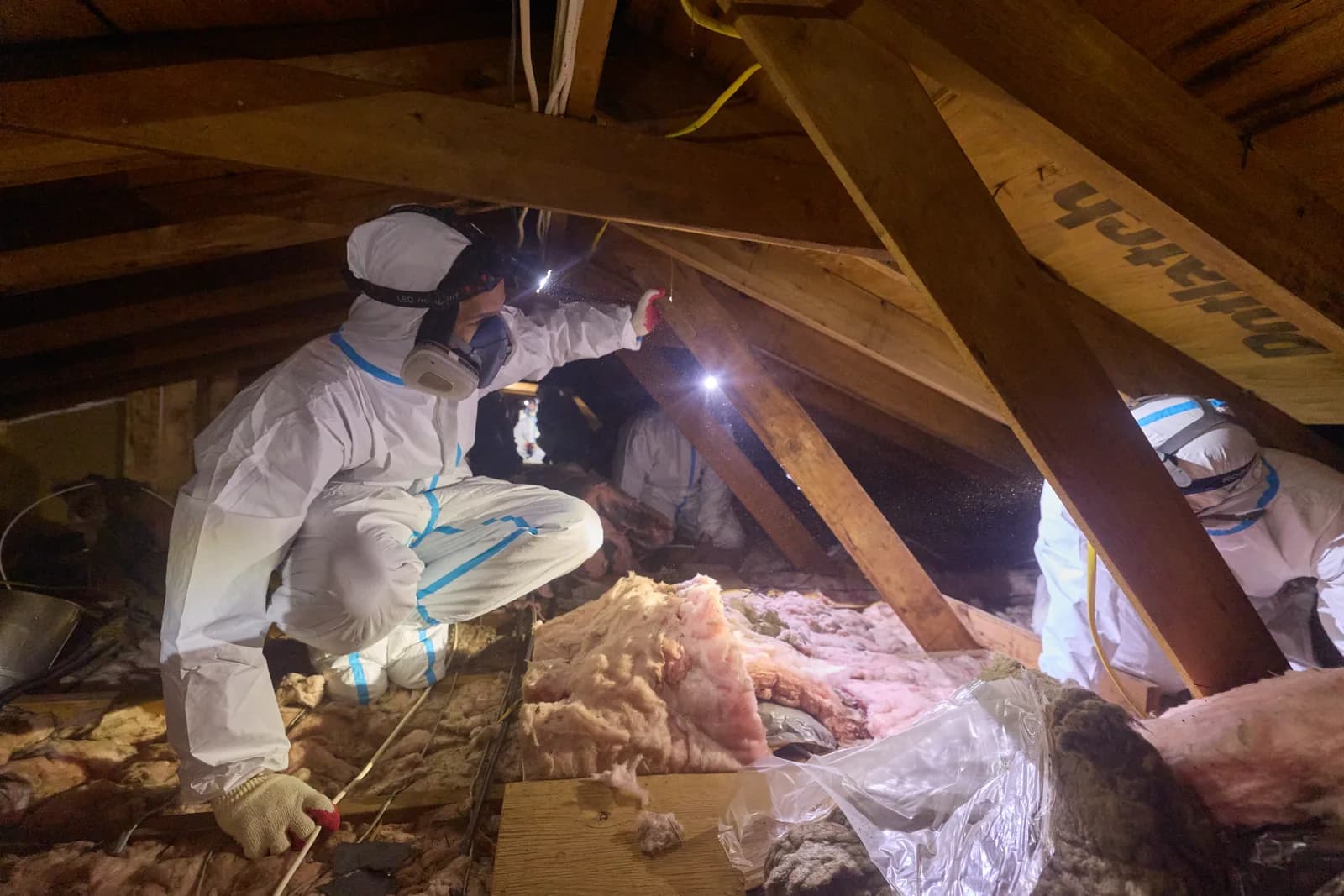
When animals have been living in an attic for months or years, the insulation is usually destroyed. Between the nesting, the droppings, the urine, and the general trampling, the insulation loses its effectiveness and becomes a health concern.
A full attic restoration involves removing the contaminated insulation, sanitizing the attic space, and installing new insulation. This is a bigger job, but it's sometimes the only way to truly resolve the damage.
A small attic with moderate contamination is on the lower end of the restoration range. Larger attics or severe contamination (heavy raccoon latrine, long-term bat colony guano) increase the work significantly. The good news is that new insulation often pays for itself over time through improved energy efficiency.
What Affects the Price?
Here are the main factors that push a job from smaller to larger.
- Number of animals: One squirrel is simpler than a family of five. A single bat is very different from a colony of fifty.
- Number of entry points: Every entry point needs to be sealed. A home with one gap in the soffit is a faster job than a home with gaps along three sides of the roofline.
- Attic size and accessibility: A small Cape Cod attic you can stand up in is easier to work in than a sprawling Colonial attic with tight eaves and multiple levels.
- Extent of damage: Animals that have been in the attic for a week cause a lot less damage than animals that have been there for six months. The longer the occupation, the more remediation is needed.
- Species: Different animals require different approaches, different timelines, and different levels of structural repair. Raccoon work tends to involve the most damage because raccoons are the most destructive.
- Roof height and pitch: Work at height requires ladders, safety equipment, and sometimes scaffolding. A single-story ranch is more straightforward than a three-story Colonial.
- Season: During baby season (spring), work takes longer because juvenile animals that can't be simply excluded have to be accounted for. Certain species have legal protections during specific months.
What Should Be Included in Professional Animal Removal
When you hire an animal removal company, you're not just paying someone to set a trap. Or at least, you shouldn't be. Here's what a legitimate, thorough animal removal service includes:
- Inspection: Identifying the species, locating all entry points, and assessing the damage.
- Removal or exclusion: Getting the animals out using humane, species-appropriate methods. This might mean one-way doors, live trapping, or hands-on removal for juveniles.
- Exclusion and sealing: Closing every entry point with materials that will hold up long-term. This is the most important part of the job. Effective sealing uses galvanized steel, metal flashing, heavy-gauge wire mesh, and commercial-grade sealants. Spray foam alone doesn't cut it.
- Cleanup and sanitization: Removing droppings, nesting material, and contaminated insulation where necessary. Applying antimicrobial treatments to affected areas.
- Coverage: Any company confident in their work should explain it in writing. Ideally, any service-specific coverage is tied to the approved plan so you know exactly what is and is not covered before work starts.
If a company's quote only covers trapping and doesn't mention exclusion or sealing, that's not a solution. That's a subscription.
DIY vs. Professional: An Honest Comparison
Professional animal removal isn't cheap. It's natural to wonder if you can handle it yourself. Here's an honest breakdown.
When DIY Might Work
If you have a single mouse that got in through an obvious gap, and you can safely seal that gap with steel wool and caulk, you might be fine handling it yourself. A snap trap, some patience, and a tube of sealant can solve a simple mouse problem.
When DIY Won't Work
For anything bigger than a mouse or two, DIY usually costs more in the long run. Here's why:
- You might seal animals inside. This is the most common DIY mistake. You spot a hole, you plug it, and now a raccoon is trapped in your attic. A panicked raccoon will tear through drywall, ductwork, and wiring to get out.
- You probably won't find all the entry points. Most homeowners find the obvious hole and miss the three other gaps the animals are also using. It is common for a homeowner to seal one opening only for the animals to simply move to another.
- Bat exclusion requires expert timing. Bat colonies have maternity seasons where pups are flightless, and attempting exclusion at the wrong time creates bigger problems - dead bats in your walls, worse odors, and a failed job you have to redo.
- Attic work is dangerous. Between the heights, confined spaces, contaminated insulation, and the possibility of confronting a cornered wild animal, attic animal removal is not a casual weekend project.
The math usually works out like this: a homeowner buys traps, sealants, and materials, spends a weekend trying to fix it, and calls a professional a month later when the problem comes back. Now they've spent on supplies and the professional fee. It would have been cheaper to call first.
Red Flags in Animal Removal Pricing
Not all animal removal companies price their work honestly. Here are some warning signs to watch for when comparing quotes.
- Pricing by the animal: "We charge per raccoon." This incentivizes the company to find as many animals as possible, and it doesn't address the actual problem (the entry points). Removal without exclusion is pointless.
- No inspection included: If a company quotes you a price over the phone without seeing the property, they're either guessing or they're going to hit you with add-ons once they arrive. Every home is different, and a real quote requires a real inspection.
- Extremely low pricing: If one company's quote is dramatically lower than everyone else, that low bid probably covers trapping only and doesn't include exclusion or sealing. Ask exactly what's included before comparing prices.
- Pressure to sign immediately: "This price is only good today" or "If you don't act now, the damage will double." A legitimate company will give you time to make a decision. Wildlife problems are urgent, but they're not so urgent that you can't sleep on a quote.
- No written plan or coverage explanation: If a company refuses to put the work and any service-specific coverage in writing, walk away.
- Recommending poison for wildlife: Any company that suggests poisoning raccoons, squirrels, or other wildlife is either unqualified or unethical. It's illegal for most species in NJ, and for rodents, it creates secondary problems (dead animals in walls, risk to pets and predators in the food chain).
The Real Cost of Waiting
One of the biggest factors in animal removal cost isn't the animal itself. It's how long the animal has been there. A raccoon that moved in last week is a much smaller job than a raccoon family that's been nesting in your insulation for three months. By that point, you're dealing with extensive contamination, destroyed insulation, and potentially damaged wiring or ductwork.
The longer you wait, the more it costs. That's not a sales pitch. It's just how wildlife damage works.
The pattern is always the same. Animals don't maintain your attic while they're living in it. They chew, they soil, they nest, and every day they're up there, the job grows.
Some homeowners hear noises and hope the problem will go away on its own. By the time they call six months later, the insulation is destroyed, the attic is full of droppings, and the job is several times what it would have been if they'd called when the noises started.
Get a Straight Answer
Animal removal isn't cheap. But a reputable company will tell you exactly what it costs, what's included, and why, with no hidden fees, no surprise add-ons, and no bait-and-switch.
A good inspection tells you what's going on and what it will take to fix, so you can decide from there.
That's how this should work. You have a problem, you get honest information, and you make a decision. No games.
On this page
On this page
- What Drives Animal Removal Cost
- The Species
- Raccoons
- Squirrels
- Bat Exclusion
- Rodent Exclusion (Mice and Other Rodents)
- Full Attic Restoration
- What Affects the Price?
- What Should Be Included in Professional Animal Removal
- DIY vs. Professional: An Honest Comparison
- When DIY Might Work
- When DIY Won't Work
- Red Flags in Animal Removal Pricing
- The Real Cost of Waiting
- Get a Straight Answer
