
On this page
On this page
The best attic insulation depends on your budget, existing conditions, access, air sealing needs, and what the inspection shows. According to the Department of Energy, fiberglass batts offer R-3.1 to R-3.4 per inch at $0.50 to $1.50 per square foot installed, blown-in cellulose provides R-3.2 to R-3.8 per inch at $1.00 to $2.50 per square foot, and closed-cell spray foam delivers R-6.0 to R-7.0 per inch at $2.50 to $5.00 per square foot.
Those numbers tell you part of the story. The rest comes down to your attic's geometry, what is already up there, whether you need air sealing (you almost certainly do), and what problem you are actually trying to solve. This is a breakdown of all three materials, where each one excels, and which one makes the most sense for New Jersey homes.
How do the three types compare?
Here is the side-by-side comparison, with each column unpacked below.
| Feature | Fiberglass Batts | Blown-In Cellulose | Closed-Cell Spray Foam |
|---|---|---|---|
| R-value per inch | R-3.1 to R-3.4 | R-3.2 to R-3.8 | R-6.0 to R-7.0 |
| Cost per sqft (installed) | $0.50 to $1.50 | $1.00 to $2.50 | $2.50 to $5.00 |
| Lifespan | 20 to 30 years | 20 to 30 years | 30+ years |
| Moisture resistance | Does not absorb | Absorbs and releases | Acts as moisture barrier |
| Settling | Minimal | 10-15% over time | None |
| Fire resistance | Non-combustible | Treated with borate (Class 1) | Varies by product |
| Best for | Open joist bays, full replacements | Irregular spaces, top-ups, around obstructions | Rim joists, crawl spaces, cathedral ceilings |
| DIY friendly | Moderate | No (requires machine) | No (requires professional) |
A few things jump out from this table. Spray foam has roughly double the R-value per inch, which sounds impressive until you look at the cost column and realize it also costs two to five times more. Fiberglass and cellulose are closer to each other in both performance and price, but they excel in different applications. Let's get into the specifics.
When fiberglass batts are the right choice
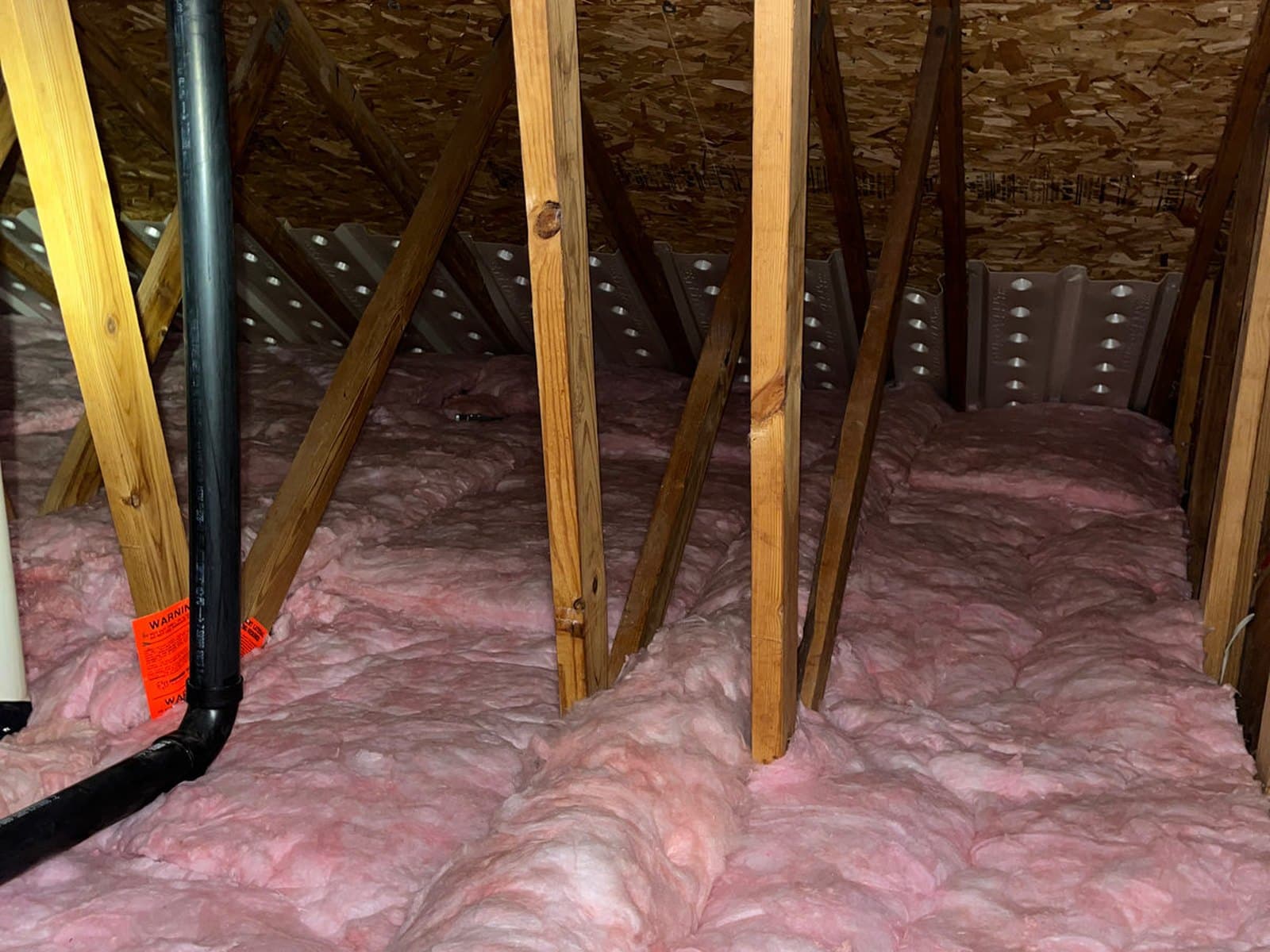
Fiberglass batts are the workhorse of residential attic insulation, and there are good reasons they have held that position for decades. They are the most commonly installed insulation for residential attic floors, and that is worth explaining honestly.
Where batts shine:
- Open joist bays. When the attic has standard, evenly spaced framing with clear access between joists, batts are fast to install and deliver their full rated R-value with no guesswork. You cut them to fit, lay them in, and the coverage is uniform.
- Full insulation replacements. After contaminated insulation is removed (a common scenario when wildlife has been in the attic), the attic floor is wide open. This is the ideal condition for batt installation: clean surfaces, visible air sealing targets, and uniform joist spacing.
- Inspectability. Batts can be lifted to check for moisture, pest activity, or air leaks during future inspections. Blown-in material buries everything, making visual inspections much harder.
- No settling. Fiberglass batts maintain their thickness and R-value over their lifespan. They do not compact under their own weight the way loose-fill materials can.
What batts are not ideal for:
Batts struggle with irregular framing, lots of obstructions (pipes, wires, junction boxes), and oddly shaped cavities. If you have to cut around 30 obstacles per joist bay, the labor goes up and the coverage quality goes down. Batts also require reasonably good access. If your attic has areas with 18 inches of clearance and a forest of HVAC ducts, batts become impractical in those zones.
Fiberglass batts work well as a primary insulation product because they are proven, cost-effective, they do not settle, and they are easy to inspect years later. Not because they are the cheapest option on a spec sheet, but because they match the building conditions found in the overwhelming majority of NJ attics.
When blown-in makes more sense
Blown-in insulation, whether cellulose or fiberglass, is applied with a machine that breaks the material into loose particles and blows it into place. It fills gaps, flows around obstructions, and conforms to irregular shapes in ways that pre-cut batts cannot.
Where blown-in excels:
- Irregular spaces and obstructions. Older NJ homes often have non-standard framing, knob-and-tube wiring remnants, ductwork running in every direction, and joist spacing that changes from one bay to the next. Blown-in material fills all of it without requiring individual cuts.
- Top-ups over existing insulation. If the existing insulation is in good condition but just not deep enough, blowing additional material on top is faster and cheaper than pulling everything out and starting over. Adding six inches of blown-in cellulose on top of existing fiberglass batts is a common and effective upgrade.
- Hard-to-reach areas. The hose from a blowing machine can reach places a person cannot. Low-clearance zones, eave areas, and spaces behind kneewalls are much easier to fill with loose material.
The cellulose settling issue:
Cellulose settles. The DOE documents that cellulose insulation loses 10 to 15 percent of its installed depth over time as it compacts under its own weight. That means an installer needs to over-fill to account for future settling. A reputable installer factors this in. An installer cutting corners does not, and the homeowner ends up with less R-value than they paid for a few years down the road.
Cellulose also absorbs moisture. It is treated with borate to resist mold and fire, and it does release moisture over time rather than trapping it permanently. But in a poorly ventilated attic, cellulose can hold moisture long enough to cause problems. Proper attic ventilation is not optional with cellulose.
Blown-in fiberglass vs. cellulose:
Blown-in fiberglass does not settle as much as cellulose and does not absorb moisture. It is lighter, which matters in older homes where ceiling structures may not welcome additional weight. Cellulose has slightly better sound dampening and a marginally higher R-value per inch. Both are legitimate options. The choice between them usually comes down to the specific attic conditions and the installer's recommendation.
Blown-in material is the right choice when the attic conditions call for it. For top-ups, irregular layouts, and hard-to-reach areas, it is the right tool.
When spray foam is worth the cost
Closed-cell spray foam is the premium option. It delivers the highest R-value per inch, acts as both insulation and air barrier in a single application, and provides structural rigidity to the surfaces it bonds to. It is also, by a wide margin, the most expensive.
Where spray foam is genuinely the best choice:
- Rim joists. The rim joist (also called the band joist) is the perimeter where the floor framing meets the foundation wall. It is a notorious source of air leakage and is almost impossible to insulate and air seal properly with batts or blown-in material. Two inches of closed-cell spray foam on the rim joist is one of the highest-value applications of the product.
- Crawl spaces. Encapsulating crawl space walls with closed-cell foam provides insulation, air sealing, and moisture control in a single step. It is particularly effective in NJ, where crawl space moisture problems are common.
- Cathedral ceilings and flat roofs. When there is no attic space and the insulation must go directly against the roof deck, spray foam is often the only option that can deliver enough insulation value in the available depth while also managing moisture.
- Spray foam on roof decking. In unvented attic assemblies (also called hot roofs), spray foam applied to the underside of the roof deck turns the attic into conditioned space. This makes sense when ductwork and HVAC equipment are in the attic and you want to bring them inside the building envelope.
An honest take:
For most existing NJ attics, fiberglass batts with proper air sealing are the better value. The joist bays are accessible for both installation and future inspection, and the air sealing can be done separately (and more precisely) before the batts go in.
Spray foam makes sense for the specific applications listed above. It does not make sense as a blanket recommendation for every attic just because it has the highest R-value number. Paying three to five times more per square foot to insulate a standard attic floor that batts handle perfectly well is spending money for bragging rights, not performance.
When an inspection determines spray foam is the right call for rim joists, a crawl space, or a specific problem area, a foam specialist is the appropriate contractor. That is more useful than pretending every attic is a spray foam attic.
What about mineral wool?
Mineral wool (often sold under the brand name Rockwool) deserves a mention because it is gaining popularity and you will see it recommended online.
The case for mineral wool:
- Higher R-value than fiberglass: R-3.7 to R-4.2 per inch vs. R-3.1 to R-3.4 for fiberglass batts.
- Non-combustible and rated to withstand temperatures up to 2,150 degrees Fahrenheit. It is genuinely fire resistant, not just fire retardant.
- Excellent sound dampening. It is denser than fiberglass and blocks noise transmission more effectively.
- Does not absorb water. Moisture runs through it rather than being absorbed.
- Semi-rigid boards hold their shape well and are easy to friction-fit.
Why it is not common in NJ residential attics (yet):
Mineral wool costs more than fiberglass batts. For attic floor insulation between joists, where the only thing sitting on top of the material is more material, the fire resistance advantage is less critical than it is in walls or around fireplaces. The higher R-value per inch matters less when you have 10 to 14 inches of joist depth to fill. And the NJ contractor base has decades of experience with fiberglass batts but less standardized workflows for mineral wool in attic applications.
Mineral wool is an excellent product, and it may see wider use in NJ attics over the next decade. Right now, for most standard attic insulation jobs, fiberglass batts remain the practical choice. If mineral wool is specifically something you want, it is worth discussing during the inspection.
The factor most people overlook: air sealing
Here is the part of attic insulation that matters more than which material you pick: air sealing.
Insulation without air sealing is like a winter coat with the zipper open. You can have R-60 of the finest insulation money can buy, but if warm air is pouring through gaps in your attic floor around light fixtures, plumbing vents, electrical penetrations, and the attic hatch, that insulation is working at a fraction of its potential.
The EPA estimates that air sealing can reduce heating and cooling costs by up to 15%. That is not a typo, and it is not from the insulation itself. That number comes from stopping the air leakage that moves conditioned air out of your living space and unconditioned attic air in.
Where the biggest air leaks hide:
- Recessed (can) lights, especially older unsealed models
- Plumbing vent pipes passing through the attic floor
- Electrical wire penetrations and junction boxes
- HVAC ductwork boots and registers
- The attic hatch or pull-down stair perimeter
- Top plates of interior partition walls
- Bathroom exhaust fan housings
- Chimney and flue chases
Every one of these is a hole in the building envelope. Sealing them with caulk, foam, or rigid material before insulation goes in is the single highest-impact step in any attic insulation project.
This is why air sealing should come before insulation on every job. And it is one reason fiberglass batts work well for the insulation itself: with the attic floor cleared and exposed for air sealing, laying batts over the freshly sealed surface is straightforward, fast, and produces a clean result.
Insulation without air sealing is like a winter coat with the zipper open. The air sealing is where most of the comfort and savings actually come from.
Which insulation is best for NJ specifically?
New Jersey has existing homes from many eras, and those attics do not all need the same insulation target. New construction and code-driven projects have their own requirements. Existing homes should be inspected first because current depth, air sealing, ventilation, access, contamination, and old material condition all change the right approach.
What that means practically:
Upgrading a shallow attic usually means adding enough depth to reach a practical performance target for that home. Standard 2x10 or 2x12 joists in NJ homes give you 9.25 to 11.25 inches of depth, and cross-layering can be used when the job calls for more coverage.
Blown-in cellulose can add coverage in irregular areas, but with 10 to 15 percent settling, the installer needs to account for final settled depth and long-term performance.
Spray foam can reach high R-values in less depth, but at several times the cost and with no advantage in a standard attic floor application where depth is not the constraint.
For most NJ attics, fiberglass batts plus air sealing is the right answer. Not because it is the cheapest option (it is, but that is not the reason). It is the right answer because it matches the building stock. NJ homes have accessible attics with standard framing, adequate joist depth, and attic floors full of penetrations that need sealing. Batts go in clean over sealed surfaces, maintain their R-value for decades, and can be lifted for future inspections.
That said, the "best" insulation is the one that is correctly installed for your specific conditions. If your attic has cathedral ceiling sections, a crawl space that needs encapsulation, or irregular framing that batts cannot handle, the answer changes. That is what the inspection is for.
Frequently Asked Questions
Can I mix insulation types in the same attic?
How do I know if my current insulation needs replacement or just a top-up?
Is spray foam insulation worth it for a standard NJ attic?
Does insulation type affect home resale value?
The Bottom Line
There is no single best insulation material. There is the best material for your specific attic, your budget, and the problem you are solving. For the majority of NJ homes, that answer is fiberglass batts with air sealing. For irregular spaces and top-ups, blown-in makes more sense. For rim joists, crawl spaces, and cathedral ceilings, spray foam earns its premium.
The real question is not which material to pick. It is whether your attic has been properly inspected, whether air sealing is part of the plan, and whether the installer knows what they are doing. Get those three things right and the material choice almost takes care of itself.
Last Updated: April 2026
